Category: IPO Preparedness Data

  • Commodities Are Talking — And Market Cap Is Listening

    Commodities Are Talking — And Market Cap Is Listening

    By Bosstox Newsroom

    After today’s Fed decision, the market did what it always does after the Fed stops being dramatic:

    It started telling the truth again.

    Not through headlines.

    Not through speeches.

    Through prices.

    And right now the truth is this:

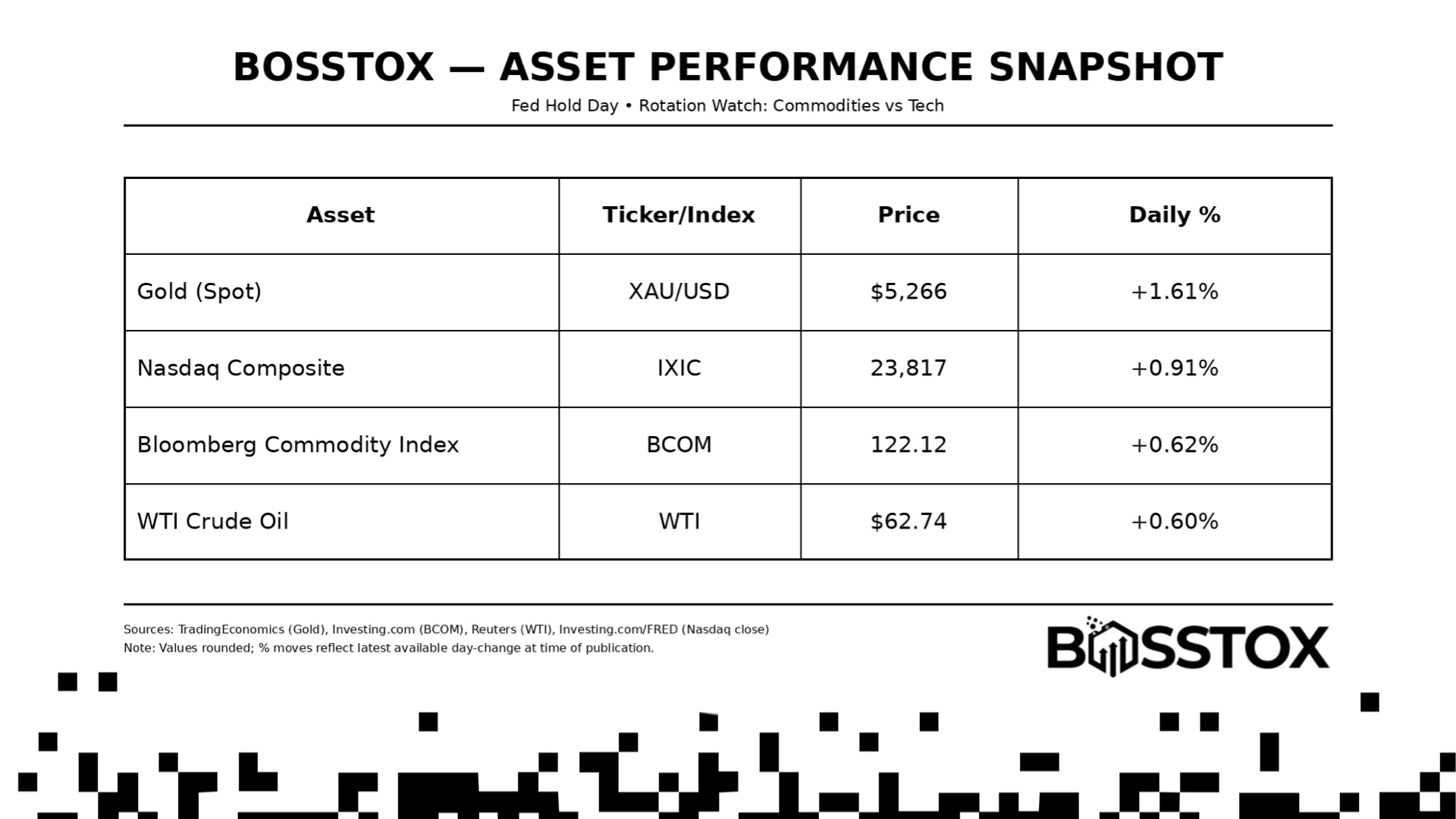
    • Commodities are moving like inflation isn’t dead
    • Market cap is acting like growth isn’t safe
    • Gold is screaming
    • Tech is bleeding
    • and the overall market is whispering one word:

    Reshift.

    Inflation Isn’t “Coming Back” — It Never Fully Left

    People keep saying “inflation might return.”

    Bosstox disagrees with the framing.

    Because inflation never vanished. It just changed form.

    It went from:

    • groceries + gas

    to:

    • insurance + labor + services + rent pressure + supply chain costs

    Inflation doesn’t disappear.

    It migrates.

    And commodities are where inflation shows up first — not last.

    That’s why commodities matter so much right now: they’re early-warning systems for what pricing power is doing across the economy.

    When commodities spike, companies get squeezed.

    When companies get squeezed, they cut.

    When they cut, labor slows.

    When labor slows, recession probability climbs.

    So yes— commodities and inflation are directly linked.

    But more importantly:

    commodities and recession are linked too.

    Market Cap = Market Confidence

    Let’s talk market cap.

    Market cap isn’t just a number — it’s the market’s collective vote on future stability.

    When capital rotates away from mega caps (especially tech), the market is saying:

    “We’re less certain about tomorrow than we were yesterday.”

    That’s what we’re watching now.

    The market is leaning into defense, not fantasy.

    And the “dip” you’re seeing isn’t random:

    It’s market cap re-pricing risk.

    In plain English:

    • big money is rebalancing
    • institutions are cleaning portfolios
    • and retail hasn’t fully realized the shift yet

    Gold at All-Time High While Tech Bleeds = The Loudest Signal in Finance

    Read this slow:

    Gold is at an all-time high… while tech is down.

    That combination is not normal.

    Gold tends to rise when:

    • confidence drops
    • currency weakens
    • inflation pressure lingers
    • global stability deteriorates
    • recession risk rises

    Tech tends to fall when:

    • rates stay elevated
    • liquidity tightens
    • risk appetite shrinks
    • future earnings get discounted harder
    • market cap concentration becomes dangerous

    So when gold is ripping and tech is slipping, the market is basically announcing:

    “We don’t trust the future the way we did.”

    That is not fear.

    That is positioning.

    And positioning moves the world.

    Stocks Dipping While Commodities React = Stagflation Shadow

    Here’s the danger zone Bosstox watches harder than anything:

    • stocks weakening (growth fear)
    • commodities staying strong (inflation pressure)

    That mix breeds one monster:

    stagflation vibes

    Not necessarily stagflation itself, but the shadow of it.

    Because if:

    • pricing power stays elevated
    • but demand starts slowing

    then the Fed gets stuck in the worst possible setup:

    ✅ inflation isn’t low enough to cut fast

    ✅ growth isn’t strong enough to tolerate tight policy

    ✅ recession becomes possible without “relief”

    That’s when mistakes happen.

    And that’s when markets drop hard.

    “It’s Time to Reshift” Isn’t a Motivational Quote — It’s an Institutional Directive

    Let’s be blunt.

    This is not the environment to blindly worship tech.

    Not the environment to chase hype.

    Not the environment to “buy the dip” like it’s 2021.

    This environment is:

    reshift season

    A rotation.

    A reorganization.

    A corporate-level portfolio rewrite.

    This is where capital moves like an army, not a lottery ticket.

    That means we are likely to see:

    • less concentration
    • more value + commodity exposure
    • more defensive allocations
    • more money parked
    • more restructuring

    The Banker Closet: Why This Market Feels Like Reorganizing a Business

    This week, the CEO of Boston Made spoke with a banker — and the banker said something that Bosstox won’t forget:

    “The market is like a closet. Everything’s being pulled out, refolded, reorganized… and put back in a better place.”

    That’s the best analogy for what’s happening in America right now.

    Not collapse.

    Not explosion.

    Restructure.

    Re-stack.

    Re-label.

    Re-file.

    Rebuild.

    Businesses are doing the same thing.

    They’re not growing wildly.

    They’re tightening.

    Optimizing.

    Creating space.

    Repositioning teams.

    Reducing waste.

    Securing credit lines.

    Rewriting supply chains.

    Big Organizations Aren’t Moving Alone — They’re Moving Through Intermediaries

    Here’s another Bosstox truth the headlines ignore:

    Most organizations don’t restructure directly.

    They restructure through:

    • bankers
    • lenders
    • private equity
    • consultants
    • insurance intermediaries
    • compliance + finance teams
    • third-party administrators
    • procurement pipelines

    They don’t say “we’re weak.”

    They say:

    • “We’re realigning”
    • “We’re optimizing”
    • “We’re improving efficiency”
    • “We’re undergoing a transformation”

    But translation?

    They’re preparing for a tighter world.

    A more expensive world.

    A world where:

    • debt costs more
    • consumers hesitate
    • and profits must be defended

    That’s why restructuring is everywhere.

    Not just in small businesses.

    In massive ones.

    Bosstox Forecast (No Fluff): Inflation Risk + Recession Probability Can Rise Together

    People think inflation and recession can’t happen together.

    False.

    They can rise together if:

    • supply costs stay elevated
    • labor cost stays sticky
    • currency pressure increases
    • and demand slows

    That’s why commodities + market cap matter.

    This is the scoreboard.

    If commodities remain strong while the market dips, inflation isn’t “gone.”

    It’s just changing shape while growth slows.

    That is the condition that breaks confidence.

    Final Word: This Is the Reorganization Economy

    This is not the boom economy.

    Not yet.

    This is not the crash economy.

    Not yet.

    This is:

    the reorganization economy

    The economy where:

    • portfolios get reshuffled
    • businesses restructure
    • credit becomes selective
    • and winners are built in silence

    So when you see:

    • gold up
    • tech down
    • commodities reacting
    • market cap rotating

    don’t panic.

    Don’t worship.

    Reposition.

    Because the closet is being reorganized.

    And the people who understand that early…

    are the people who come out dressed like kings.
  • Non-Binary Classification of Assets

    Non-Binary Classification of Assets

    The Bosstox Framework for Classifying Value in a Future NYSE IPO Ecosystem (Boston Made, Inc.)

    In traditional accounting and finance, assets are usually sorted into simple buckets:

    • tangible vs intangible
    • current vs non-current
    • operating vs non-operating
    • liquid vs illiquid

    But Boston Made isn’t a traditional company.

    Boston Made is a conglomerate ecosystem — with a parent company structure, multiple subsidiaries, digital platforms, brand media, product ventures, and a growing base of intellectual property rights (IPR). As the company prepares for what may become a future NYSE listing, the complexity of this ecosystem makes one truth unavoidable:

    Binary classification of assets is too primitive for modern conglomerates.

    That is why BOSSTOX introduces a more IPO-relevant approach:

    Non-binary classification of assets — a structured framework that recognizes assets as multi-dimensional value systems, not one-line items on a balance sheet.

    Because in the public markets, value is not only what you own.

    Value is what you can prove, defend, scale, disclose, audit, and compound.

    1) What “Non-Binary” Means in Asset Classification

    In Bosstox terms, “non-binary” means:

    ✅ An asset can be multiple things at once.

    A website can be:

    • a marketing asset
    • a revenue generator
    • a distribution platform
    • an IP container
    • a trust system
    • a future standalone subsidiary

    Traditional classification tries to reduce that into one label.

    Bosstox does the opposite:

    Bosstox treats assets as layered.

    And for IPO readiness, this matters because public markets reward companies that can clearly show:

    • defensible assets
    • repeatable systems
    • scalable infrastructure
    • explainable value

    2) Why This Matters for Boston Made’s 2026 IPO Vision

    Your Bosstox messaging already defines the north star:

    • Built for public-market discipline
    • Financial nervous system of the ecosystem
    • Pre-IPO platform to long-term value engine
    • Transparency & compliance
    • Institutional-grade clarity

    A future IPO will require Boston Made to clearly demonstrate that it is not:

    • “a bunch of small companies”
    • “a loose portfolio”
    • “a collection of websites”

    But instead:

    A structured, governed, monetizable ecosystem of assets — with measurable economic output and intellectual property protection.

    This is where non-binary asset classification becomes a strategic advantage.

    Because it allows Boston Made to speak the language of:

    • analysts
    • institutional investors
    • auditors
    • SEC frameworks
    • underwriters
    • NYSE expectations

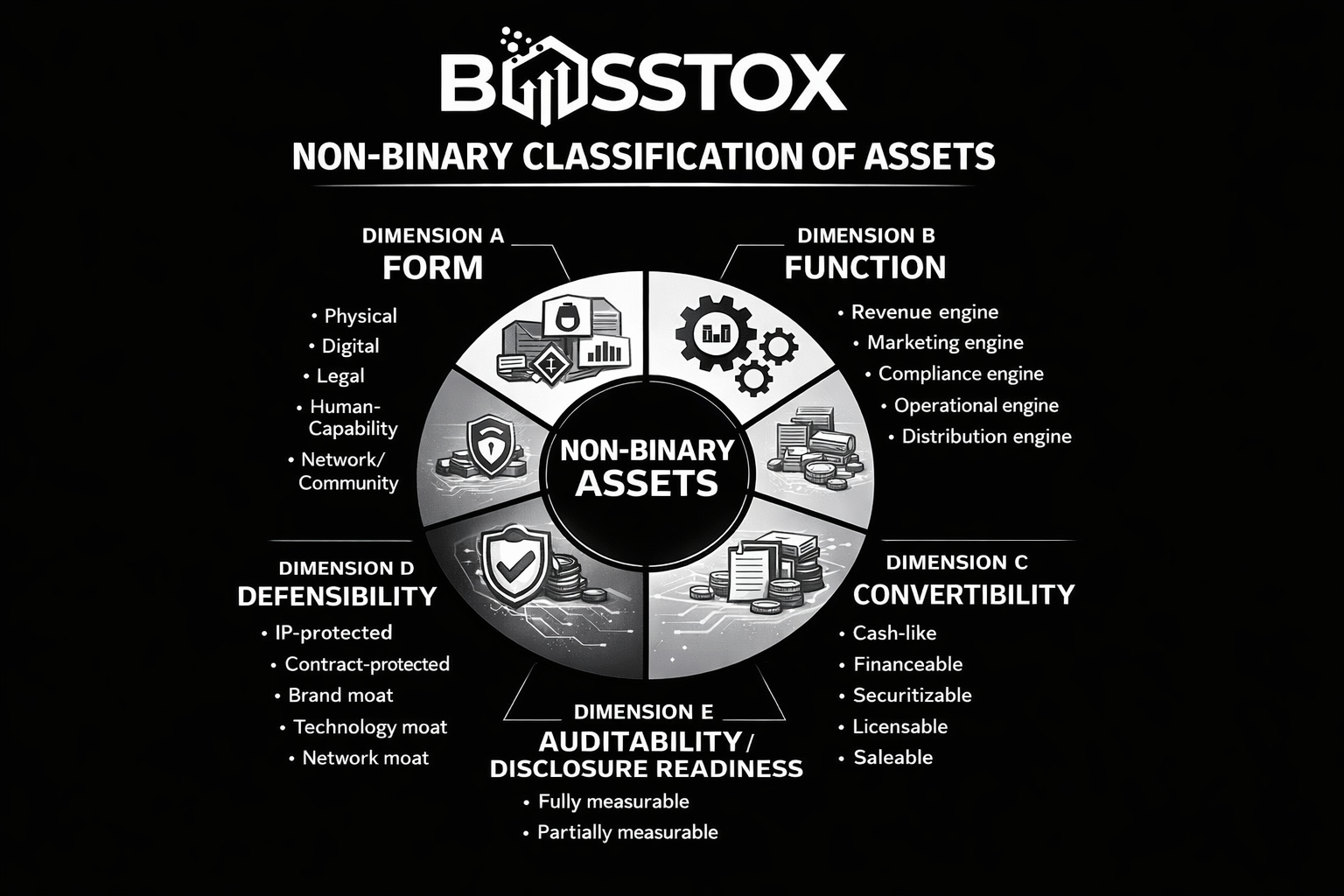
    3) The BOSSTOX Non-Binary Asset Taxonomy (NBA Model)

    Bosstox classifies assets across multiple dimensions, not just one.

    Dimension A — Form

    • Physical
    • Digital
    • Legal
    • Human-capability
    • Network/community

    Dimension B — Function

    • revenue engine
    • marketing engine
    • compliance engine
    • operational engine
    • distribution engine

    Dimension C — Convertibility

    • cash-like
    • financeable
    • securitizable
    • licensable
    • saleable

    Dimension D — Defensibility

    • IP-protected
    • contract-protected
    • brand moat
    • technology moat
    • network moat

    Dimension E — Auditability / Disclosure Readiness

    • fully measurable
    • partially measurable
    • narrative-only (must be engineered into measurable systems)

    This gives Bosstox a way to explain assets the way Wall Street thinks:

    What is it? What does it do? Can it scale? Can it be defended? Can it be audited? Can it be disclosed?

    4) Examples Inside Boston Made (Subsidiaries + IPR)

    Example 1: BOSSTOX Itself

    Bosstox is not just software.

    It is:

    • a platform (digital asset)
    • a reporting engine (compliance asset)
    • a market narrative (brand asset)
    • a long-term fintech product (venture asset)
    • a governance layer (public-company readiness asset)

    Non-binary classification = Bosstox is simultaneously infrastructure + product + governance.

    Example 2: Fenway Web

    Fenway Web is not “a web agency.”

    In IPO terms, it is:

    • internal developer studio (operational asset)
    • IP creation engine (intangible asset generator)
    • digital pipeline (lead asset)
    • ecosystem infrastructure (systems asset)

    Fenway Web becomes an internal force multiplier.

    Wall Street doesn’t just pay for services.

    It pays for systems that multiply output.

    Example 3: Boston Made Pets

    Boston Made Pets isn’t only a brand.

    It is also:

    • a consumer product platform
    • a data-generating channel
    • a subscription engine
    • a licensing opportunity
    • a defensible identity via trademarks + design language

    This is where the IPR side becomes central.

    Because in public markets:

    IPRs are monetization permissions.

    They are legally enforceable exclusivity — the closest thing business has to “ownership of demand.”

    5) The IPO Weapon: IPR as a Portfolio, Not a Footnote

    The strongest IPO candidates don’t have “some IP.”

    They have an IP portfolio with business integration.

    In Boston Made’s case, IPR may include:

    • trademarks
    • logos
    • brand names
    • content libraries
    • proprietary frameworks
    • software architecture
    • databases
    • original media / editorial content

    This matters because it means Boston Made isn’t just producing revenue.

    Boston Made is producing:

    compounding intellectual property with monetizable rights.

    Non-binary classification allows Bosstox to show the market:

    • which brands are revenue now
    • which brands are strategic infrastructure
    • which assets are licensable
    • which assets are spin-off candidates
    • which assets build the “moat”

    6) Why Inflation, CPI, and Market Stability Tie Into This

    Your Bosstox positioning around inflation (CPI ~2.7% and core ~2.6%) ties perfectly into this logic:

    When inflation shifts the behavior of money, weak systems break.

    So Bosstox argues:

    value belongs to engineered systems — not optimism.

    Non-binary asset classification is exactly that:

    • it’s engineered
    • it’s measurable
    • it’s disciplined
    • it supports compliance and investor trust

    This is the philosophy of public markets.

    7) Closing: Non-Binary Assets Create Binary Outcomes

    (Trust or No Trust)

    In the end, public markets operate on one final binary:

    • trustworthy or not trustworthy
    • disciplined or fragile
    • institutional-grade or retail-hype
    • audit-ready or story-only

    So Boston Made’s non-binary asset system produces a binary outcome:

    Public-market trust.

    And Bosstox becomes the translator between:

    • Boston Made’s creative ecosystem
      and
    • Wall Street’s demand for visibility, controls, and defendable value

    Bosstox, Boston Made, Non-Binary Assets, Asset Classification, IPO Readiness, NYSE IPO, Intellectual Property Rights, IPR, Subsidiary Structure, Parent Company, Conglomerate Strategy, Capital Markets, Pre-IPO Strategy, Asset Valuation, Intangible Assets, Digital Infrastructure, Platform Ecosystem, Governance, Compliance, SEC Readiness, Transparency, Risk Management, Financial Discipline, Market Intelligence, Systems Thinking, Public Company Preparation, Institutional Investors

  • Trump, Defense Stocks, and the End of Buybacks: A Market Thesis Built on Borders

    Trump, Defense Stocks, and the End of Buybacks: A Market Thesis Built on Borders

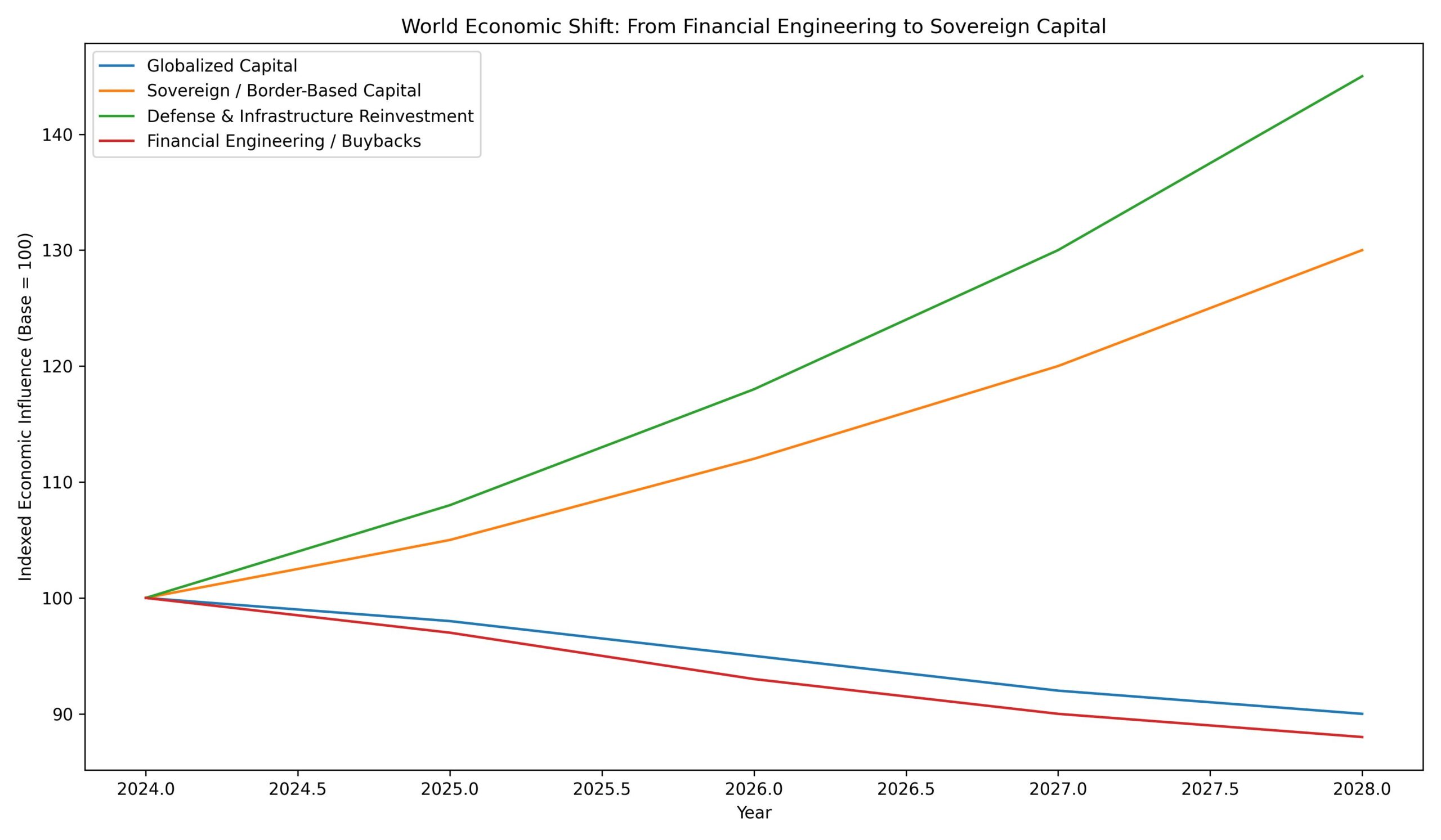
    In a series of sweeping economic claims, Donald Trump has once again put the global financial system on notice. At the center of his argument is a radical idea: defense companies operating across NATO-aligned countries should not be allowed to use capital for stock buybacks. Instead, that capital, he argues, should be redirected toward production, labor, domestic manufacturing, and border security.

    Trump claims that under this framework, the stock market could ultimately double—not through financial engineering, but through forced reinvestment, territorial leverage, and geopolitical consolidation.

    Whether one agrees or not, the implications for markets, defense equities, and global capital flows are enormous.

    Stock Buybacks vs. Strategic Capital

    For decades, stock buybacks have been a primary driver of equity price appreciation—especially in large defense contractors. Buybacks reduce share count, inflate earnings per share, and reward shareholders without necessarily expanding real output.

    Trump’s claim is that this model is no longer compatible with a world defined by borders, military readiness, and supply-chain nationalism.

    If defense companies are essential to national security, he argues, then capital should be treated as strategic infrastructure, not shareholder candy. In his view:

    • Buybacks weaken long-term production capacity
    • Capital should be locked into domestic reinvestment
    • Defense firms should align with national objectives, not quarterly EPS optics

    From a market perspective, banning or limiting buybacks would compress short-term valuations—but potentially expand long-term enterprise value through real assets, labor, and production scale.

    NATO, Borders, and Capital Discipline

    Trump’s rhetoric consistently ties NATO obligations to economic accountability. His position implies that countries benefiting from U.S. defense umbrellas must also accept capital discipline—especially in firms that profit directly from military spending.

    This reframes NATO not just as a military alliance, but as a capital alliance:

    • Defense spending becomes tied to domestic investment
    • Cross-border profit extraction is discouraged
    • National borders reassert themselves as economic boundaries

    In this model, markets stop being purely global and start behaving regionally, with defense, energy, and infrastructure stocks priced based on sovereign alignment, not just revenue.

    Greenland, ICE, and Economic Borders

    Trump’s repeated references to Greenland—including claims that the U.S. should acquire it “one way or another”—are less about territory and more about strategic assets. Greenland represents:

    • Arctic access
    • Rare earth resources
    • Military positioning
    • Control over future trade routes

    Similarly, his ICE-related claims frame border enforcement as economic policy, not just immigration control. In this worldview, borders determine:

    • Labor flows
    • Capital flows
    • Tax bases
    • Market stability

    Markets, in turn, become reflections of who controls land, resources, and movement—not just interest rates.

    Will the Stock Market Double?

    Trump’s claim that the stock market will double rests on a specific thesis:

    1. End financial engineering (buybacks)
    2. Force reinvestment into real assets
    3. Secure borders and supply chains
    4. Expand U.S.-aligned territory and influence
    5. Reprice equities based on production, not leverage

    If executed, this would represent a structural reset, not a cyclical rally. Some sectors would suffer short-term shocks—particularly defense, aerospace, and multinational firms—but others could see historic expansion, especially:

    • Domestic manufacturing
    • Energy
    • Infrastructure
    • Defense production (not defense finance)

    Where BOSSTOX and Boston Made Fit

    At Boston Made, the thesis has always centered on real value creation over abstraction—brands, infrastructure, media, education, and long-term systems built for durability, not arbitrage.

    BOSSTOX sits at the intersection of this shift: a framework designed to track and communicate value rooted in execution, assets, and ecosystem growth, not just speculative multiples.

    If markets move toward:

    • Capital discipline
    • Domestic reinvestment
    • Sovereign-aligned growth

    Then platforms that emphasize transparency, structure, and long-term alignment become more relevant—not less.

    Final Thought

    Trump’s claims—on buybacks, NATO, borders, ICE, and even Greenland—are not random. They form a single economic argument: the era of borderless capital may be ending.

    If markets are entering a phase defined by territory, production, and control, then the next decade won’t reward the fastest traders—it will reward the most grounded builders.

    Whether the market doubles or not, one thing is clear:

    The rules being debated are no longer just financial. They’re geopolitical.

  • Inflation vs. Markets: What CPI Really Means for Investors in 2026

    Inflation vs. Markets: What CPI Really Means for Investors in 2026


    Inflation isn’t just an economic headline — it’s a force that reshapes purchasing power, investment strategy, and long-term wealth. As the Consumer Price Index (CPI) continues to evolve post-pandemic, understanding how inflation interacts with market performance is no longer optional. It’s essential.

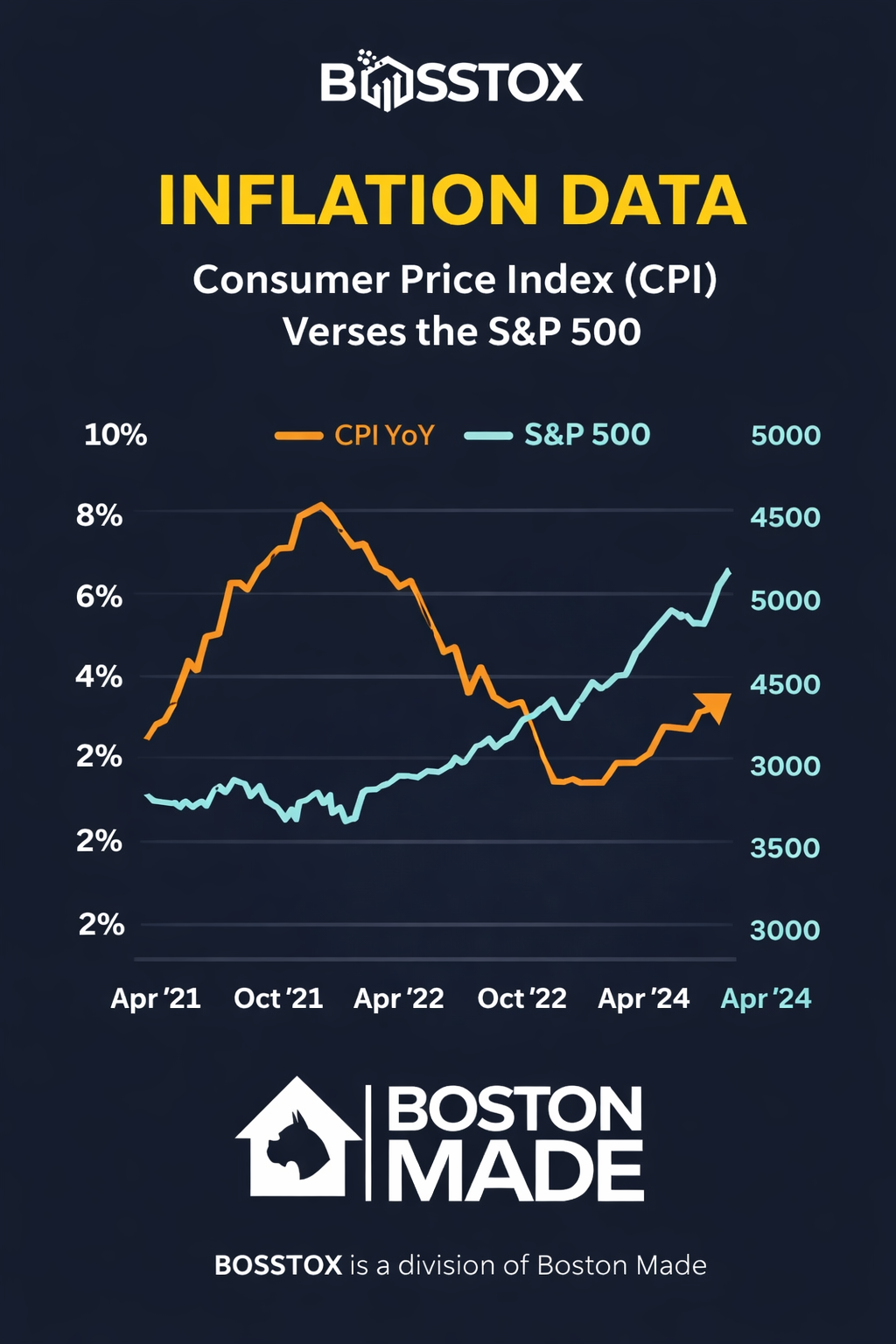
    At BOSSTOX, a division of Boston Made, we believe clarity creates confidence. That’s why we track CPI alongside the S&P 500 — not as isolated metrics, but as interconnected signals that tell a broader story about economic momentum, risk, and opportunity.


    What the CPI Tells Us About Inflation

    The Consumer Price Index measures the average change in prices paid by consumers for everyday goods and services — from groceries and rent to energy and transportation. When CPI rises, inflation accelerates. When it cools, purchasing power stabilizes.

    Over the past several years, CPI surged to levels not seen in decades, peaking as supply chains tightened, stimulus flooded the economy, and demand rebounded aggressively. While inflation has since moderated, it remains structurally higher than the pre-2020 norm — a reality that continues to influence interest rates, wages, and asset prices.

    Inflation isn’t just about higher prices. It’s about currency behavior. When inflation rises, money buys less — forcing investors to seek assets that can outpace that erosion.


    The S&P 500: Markets React, Then Adapt

    The S&P 500 tells a different — but complementary — story.

    As inflation initially spiked, markets struggled. Higher CPI triggered aggressive monetary tightening, pressuring valuations and increasing volatility. But markets are forward-looking. Once inflation showed signs of stabilizing, equities began pricing in future growth, productivity gains, and earnings expansion.

    Historically, the S&P 500 has acted as a long-term hedge against inflation — not because stocks are immune to it, but because businesses adapt. Prices adjust, revenues grow, and innovation finds a way forward.

    The divergence between CPI and the S&P 500 highlights a critical truth: inflation shocks markets in the short term, but disciplined capital allocation wins over time.


    Why This Relationship Matters Now

    Understanding CPI versus market performance isn’t about timing trades — it’s about building strategy.

    • Inflation impacts cash first — savings lose real value if returns don’t exceed CPI
    • Markets reprice risk quickly — volatility often precedes opportunity
    • Long-term growth favors assets that scale — innovation, productivity, and earnings matter more than fear

    For founders, operators, and forward-thinking investors, this environment demands adaptability. Static strategies fail in dynamic economies.


    BOSSTOX Perspective: Data Over Noise

    At BOSSTOX, we don’t chase headlines — we analyze systems.

    Inflation data helps us understand the cost of capital. Market data helps us understand sentiment and growth expectations. When viewed together, CPI and the S&P 500 provide a powerful lens into where the economy has been — and where it’s likely going next.

    This is especially important as Boston Made builds toward its long-term vision. Sustainable growth isn’t built on speculation. It’s built on measured risk, informed decision-making, and economic literacy.


    The Bottom Line

    Inflation changes the rules — but it doesn’t end the game.

    Those who understand how CPI influences markets are better equipped to protect value, deploy capital intelligently, and build resilient strategies in uncertain times. Whether you’re an investor, entrepreneur, or operator, the lesson is the same:

    Data beats emotion. Strategy beats reaction.

    And in an inflationary world, understanding the relationship between prices and markets isn’t just smart — it’s necessary.


    BOSSTOX is a division of Boston Made.
    For more insights on markets, inflation, and long-term economic strategy, visit bosstox.com.

Pin It on Pinterest