
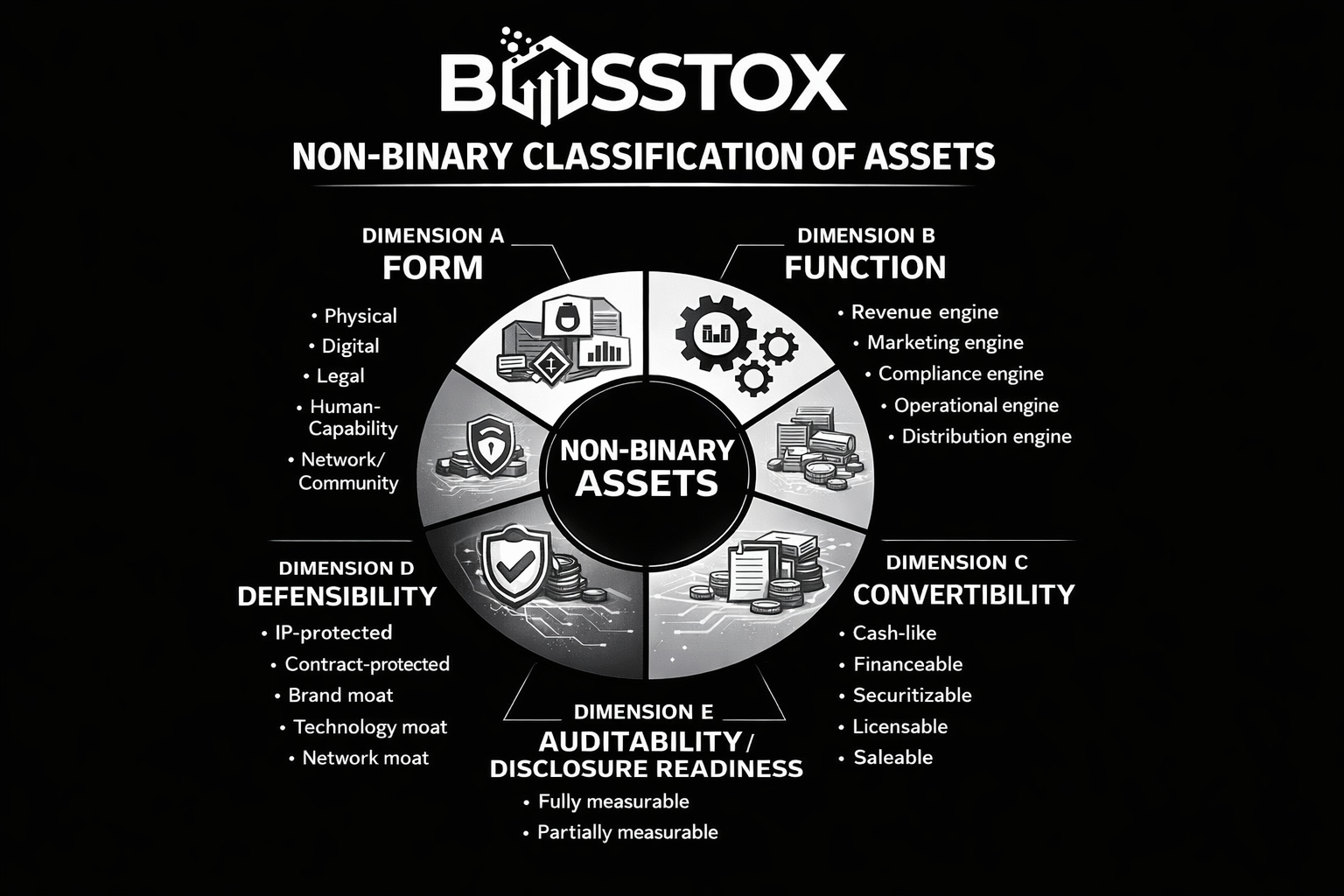
The Bosstox Framework for Classifying Value in a Future NYSE IPO Ecosystem (Boston Made, Inc.)
In traditional accounting and finance, assets are usually sorted into simple buckets:
- tangible vs intangible
- current vs non-current
- operating vs non-operating
- liquid vs illiquid
But Boston Made isn’t a traditional company.
Boston Made is a conglomerate ecosystem — with a parent company structure, multiple subsidiaries, digital platforms, brand media, product ventures, and a growing base of intellectual property rights (IPR). As the company prepares for what may become a future NYSE listing, the complexity of this ecosystem makes one truth unavoidable:
Binary classification of assets is too primitive for modern conglomerates.
That is why BOSSTOX introduces a more IPO-relevant approach:
Non-binary classification of assets — a structured framework that recognizes assets as multi-dimensional value systems, not one-line items on a balance sheet.
Because in the public markets, value is not only what you own.
Value is what you can prove, defend, scale, disclose, audit, and compound.
1) What “Non-Binary” Means in Asset Classification
In Bosstox terms, “non-binary” means:
✅ An asset can be multiple things at once.
A website can be:
- a marketing asset
- a revenue generator
- a distribution platform
- an IP container
- a trust system
- a future standalone subsidiary
Traditional classification tries to reduce that into one label.
Bosstox does the opposite:
Bosstox treats assets as layered.
And for IPO readiness, this matters because public markets reward companies that can clearly show:
- defensible assets
- repeatable systems
- scalable infrastructure
- explainable value
2) Why This Matters for Boston Made’s 2026 IPO Vision
Your Bosstox messaging already defines the north star:
- Built for public-market discipline
- Financial nervous system of the ecosystem
- Pre-IPO platform to long-term value engine
- Transparency & compliance
- Institutional-grade clarity
A future IPO will require Boston Made to clearly demonstrate that it is not:
- “a bunch of small companies”
- “a loose portfolio”
- “a collection of websites”
But instead:
A structured, governed, monetizable ecosystem of assets — with measurable economic output and intellectual property protection.
This is where non-binary asset classification becomes a strategic advantage.
Because it allows Boston Made to speak the language of:
- analysts
- institutional investors
- auditors
- SEC frameworks
- underwriters
- NYSE expectations
3) The BOSSTOX Non-Binary Asset Taxonomy (NBA Model)
Bosstox classifies assets across multiple dimensions, not just one.
Dimension A — Form
- Physical
- Digital
- Legal
- Human-capability
- Network/community
Dimension B — Function
- revenue engine
- marketing engine
- compliance engine
- operational engine
- distribution engine
Dimension C — Convertibility
- cash-like
- financeable
- securitizable
- licensable
- saleable
Dimension D — Defensibility
- IP-protected
- contract-protected
- brand moat
- technology moat
- network moat
Dimension E — Auditability / Disclosure Readiness
- fully measurable
- partially measurable
- narrative-only (must be engineered into measurable systems)
This gives Bosstox a way to explain assets the way Wall Street thinks:
What is it? What does it do? Can it scale? Can it be defended? Can it be audited? Can it be disclosed?
4) Examples Inside Boston Made (Subsidiaries + IPR)
Example 1: BOSSTOX Itself
Bosstox is not just software.
It is:
- a platform (digital asset)
- a reporting engine (compliance asset)
- a market narrative (brand asset)
- a long-term fintech product (venture asset)
- a governance layer (public-company readiness asset)
Non-binary classification = Bosstox is simultaneously infrastructure + product + governance.
Example 2: Fenway Web
Fenway Web is not “a web agency.”
In IPO terms, it is:
- internal developer studio (operational asset)
- IP creation engine (intangible asset generator)
- digital pipeline (lead asset)
- ecosystem infrastructure (systems asset)
Fenway Web becomes an internal force multiplier.
Wall Street doesn’t just pay for services.
It pays for systems that multiply output.
Example 3: Boston Made Pets
Boston Made Pets isn’t only a brand.
It is also:
- a consumer product platform
- a data-generating channel
- a subscription engine
- a licensing opportunity
- a defensible identity via trademarks + design language
This is where the IPR side becomes central.
Because in public markets:
IPRs are monetization permissions.
They are legally enforceable exclusivity — the closest thing business has to “ownership of demand.”
5) The IPO Weapon: IPR as a Portfolio, Not a Footnote
The strongest IPO candidates don’t have “some IP.”
They have an IP portfolio with business integration.
In Boston Made’s case, IPR may include:
- trademarks
- logos
- brand names
- content libraries
- proprietary frameworks
- software architecture
- databases
- original media / editorial content
This matters because it means Boston Made isn’t just producing revenue.
Boston Made is producing:
compounding intellectual property with monetizable rights.
Non-binary classification allows Bosstox to show the market:
- which brands are revenue now
- which brands are strategic infrastructure
- which assets are licensable
- which assets are spin-off candidates
- which assets build the “moat”
6) Why Inflation, CPI, and Market Stability Tie Into This
Your Bosstox positioning around inflation (CPI ~2.7% and core ~2.6%) ties perfectly into this logic:
When inflation shifts the behavior of money, weak systems break.
So Bosstox argues:
value belongs to engineered systems — not optimism.
Non-binary asset classification is exactly that:
- it’s engineered
- it’s measurable
- it’s disciplined
- it supports compliance and investor trust
This is the philosophy of public markets.
7) Closing: Non-Binary Assets Create Binary Outcomes
(Trust or No Trust)
In the end, public markets operate on one final binary:
- trustworthy or not trustworthy
- disciplined or fragile
- institutional-grade or retail-hype
- audit-ready or story-only
So Boston Made’s non-binary asset system produces a binary outcome:
Public-market trust.
And Bosstox becomes the translator between:
- Boston Made’s creative ecosystem
and - Wall Street’s demand for visibility, controls, and defendable value
Bosstox, Boston Made, Non-Binary Assets, Asset Classification, IPO Readiness, NYSE IPO, Intellectual Property Rights, IPR, Subsidiary Structure, Parent Company, Conglomerate Strategy, Capital Markets, Pre-IPO Strategy, Asset Valuation, Intangible Assets, Digital Infrastructure, Platform Ecosystem, Governance, Compliance, SEC Readiness, Transparency, Risk Management, Financial Discipline, Market Intelligence, Systems Thinking, Public Company Preparation, Institutional Investors
Leave a Reply