
Power & Grid
FERC’s Large-Load Orders: The November 16 Grid Deadline Behind the AI Build-Out
FERC told all six grid operators it regulates to justify or rewrite their rules for connecting data centers and other large loads. After extensions, the answers are due November 16. Here is what to watch.

For most of the AI build-out, the hard question about a new data center has been about hardware: can the operator get the accelerators, the transformers and the cooling equipment? A slower question sits underneath all of them. Who decides how a 300-megawatt customer connects to the transmission grid, how long the study takes, and who pays if the project never arrives?
On June 18, 2026, the Federal Energy Regulatory Commission put that question to every grid operator it regulates. It issued six show cause orders, one each to PJM, MISO, SPP, CAISO, ISO New England and NYISO. Each order tells the operator and its transmission owners to either prove their current rules for large loads are just and reasonable or file new ones. After extensions, the responses are now due on November 16, 2026, for five of the six regions and November 20 for SPP.
This article explains what FERC asked for, where each step stands, and what the filings will tell readers following AI infrastructure.
How the grid got here
Generators that connect to the transmission grid have long had a federal process: a queue, studies and a standard agreement. Large consumers of electricity mostly did not. A new factory or data center usually connected through its local utility under rules set largely by states. That arrangement worked when a large industrial customer meant tens of megawatts. It strains when single campuses ask for hundreds of megawatts, sometimes with their own generation on site.
In October 2025 the Secretary of Energy used his authority under the Department of Energy Organization Act to send FERC an advance notice of proposed rulemaking on large-load interconnection, opened as Docket No. RM26-4-000. FERC says its staff reviewed more than 3,500 pages of public comments. Rather than issue a single national rule, the Commission chose tailored orders under Section 206 of the Federal Power Act, region by region. The rulemaking docket remains open.
FERC staff’s explainer describes the orders as covering facilities with maximum demand of at least 20 megawatts. They build on two earlier actions: a December 2025 order directing PJM to adopt transparent tariff rules for load co-located with generation, and FERC’s approval of SPP’s High Impact Large Load process.
The five issues every region must answer
Each order is tailored to its region, but all six identify the same five areas for reform:
- Faster, clearer study processes. A defined application path for large loads with accelerated study timelines, including evaluation of grid-enhancing and alternative transmission technologies.
- No cost shifting. Rules that keep upgrade costs for new large loads from landing on other customers, and public transparency into what those upgrades cost.
- Co-location and behind-the-meter generation. Clear tariff rules for data centers built next to, or behind the meter of, a power plant.
- Services for flexible loads. New transmission products, such as non-firm or contract-demand service, for customers willing to curtail during grid stress.
- Studying generation and load together. A process to study new generation alongside the nearby or co-located load it is built to serve.
The second item may matter most for public acceptance. FERC preliminarily found that operators do not publicly post enough data on the upgrades and costs needed to serve new large loads. The remedies it floated include posting each upgrade’s scope, cost and cost assignment, plus a central cost-transparency page on each operator’s website. FERC also asked whether operators should adopt standard cost recovery agreements among the grid operator, the transmission owner and the large customer. Those agreements would protect other ratepayers if a project is canceled or leaves early.
Two limits are easy to miss. The findings are preliminary, and FERC staff note the orders do not impose new transmission rates. The orders also apply going forward. FERC said they are not meant to disturb existing agreements or negotiations already near completion.
Where the clock stands
The orders set two deadlines. Within 30 days, each region had to file an informational report on how it will keep enough generation for existing and new large loads. MISO, for example, filed its report on July 20. Within 60 days, each region had to file its tariff response, unless it asked FERC to pause the case.
The operators asked for that pause, and FERC staff now list November 16 as the response date for five regions and November 20 for SPP. CAISO’s August 3 motion requested a 90-day abeyance so it could build a tailored filing with its transmission owners through an accelerated stakeholder process. MISO and its transmission owners filed a similar request the same day, and MISO reports that FERC granted it on August 14. In MISO’s case, responses are now due November 16 and answers to those responses December 16.
The pause has limits. CAISO’s motion notes that FERC said it would not grant abeyances reflexively. FERC capped them at 90 days and said it would look with great disfavor on requests to extend them further. That makes November 16 a firmer date than regulatory deadlines often are.
Some regional work is moving on a parallel track. CAISO’s published schedule takes its large-load proposal to its Board of Governors on October 28, ahead of the FERC filing. MISO separately filed interconnection reliability requirements for large loads on August 28, asking for a December 4 effective date.
What the filings will reveal
The responses will be long and technical. A handful of questions will say most of what matters about how quickly new AI capacity can connect, and on what terms.
- Study timelines. Does each region commit to a defined number of days for a large-load study, and what readiness deposits or milestones must a project show to keep its place?
- Interim service. Can a data center take non-firm or as-available service while network upgrades are built, and how often could that service be curtailed?
- Financial security. How much must a large customer commit up front, and what happens to that money if the project shrinks or is canceled?
- Co-location rules. How will regions treat a campus that sits beside a power plant, and what share of grid costs does it carry?
- Cost posting. Will upgrade costs be published per project, so state regulators and the public can see who pays?
The answers will likely differ by region. A region that offers a fast, well-defined path with clear collateral rules may attract projects that can meet those terms. A region whose answers stay open-ended may keep seeing projects wait in queues and bilateral negotiations. Readers should treat any claimed speed-up with care until the tariff language is approved and the first projects move through it.
The orders also leave a gap. Utilities outside the six RTO and ISO regions, including much of the Southeast and West, are not directly covered. FERC Chairman Laura Swett encouraged those transmission providers to pursue similar reforms through their own filings. ERCOT, which runs most of the Texas grid, is not subject to the orders.
Why this belongs on an AI-infrastructure watch list
BOSSTOX has covered the physical limits on AI capacity: transformer lead times, transmission and local grid upgrades, behind-the-meter generation and on-site storage. The FERC proceeding is the rulebook that ties those pieces together. It decides how a project enters the grid, which upgrades it triggers, and who carries the risk if forecast demand does not arrive.
The dates to watch are concrete: CAISO’s board meeting on October 28, the six responses due November 16 and 20, answers due in mid-December, and the FERC orders that follow. BOSSTOX will review the filings once they are posted and report what each region actually committed to.
This article is general information about a regulatory proceeding. It is not investment, legal or regulatory advice. Filing dates come from FERC and grid-operator documents and may change; check the dockets for the latest.
Sources
- FERC, “FERC Launches Aggressive Targeted Action to Speed Large Load Integration,” June 18, 2026: ferc.gov
- FERC Office of Public Participation, “Cost Transparency and Customer Protection Initiatives in FERC’s June 2026 Show Cause Orders for Large Load Interconnections”: ferc.gov
- California ISO, “Motion for Abeyance,” Docket No. EL26-71-000, August 3, 2026: caiso.com
- MISO, “Large Load Working Group FERC Status Report,” September 9, 2026: misoenergy.org
- Akin Gump, “FERC Issues Landmark Show Cause Orders on Large Load Interconnection,” June 2026: akingump.com
BOSSTOX Research articles are drafted with AI assistance and reviewed by our editors before publication. See our editorial standards.
Power & Grid
Battery Storage at AI Sites
Batteries cannot power a large AI campus for days, but they can make a constrained grid connection more useful, protect critical loads, and turn a rigid data center into a more flexible energy customer.

Battery storage is often pitched as the answer to the AI power problem. That is too broad. Batteries are not a substitute for a dependable energy supply, and a four-hour system does not turn a 100-megawatt campus into an island for a week.
The more useful question is what the battery is being asked to do. At an AI site, storage can bridge short outages, smooth ramp rates, reduce demand charges, provide reserve capacity, shift charging and discharging into lower-cost hours, and help a campus participate in grid programs. Its value comes from stacking those services without pretending that every function is available at the same time.
The basic sizing math
A battery has two headline ratings: power in megawatts and energy in megawatt-hours. A 50 MW / 200 MWh system can discharge at 50 MW for four hours under its stated conditions. It cannot provide 50 MW indefinitely.
An AI campus drawing 100 MW would use 200 MWh in two hours if the entire load were placed on the battery. In practice, the battery may serve only critical loads, and the data center may shed nonessential systems. The design therefore starts with a load hierarchy: cooling, networking, storage, control systems, safety systems, and selected compute loads.
The battery also needs reserve. Operators rarely plan to run to zero state of charge. They keep headroom for a second event, account for temperature, and limit charge and discharge rates to protect asset life. The usable figure is lower than the nameplate number.
The U.S. battery market is scaling quickly. EIA reported in August 2026 that operational utility-scale battery capacity reached 43.6 gigawatts by the end of 2025 and nearly 52 gigawatts after additions in the first half of 2026. EIA said developers reported another 54 gigawatts planned over the following two and a half years. That is a sign of a growing supply chain, not a guarantee that every proposed project will be built.
What batteries can solve at a data center
The first use is ride-through. A battery can cover the seconds or minutes needed for controls to respond and generators to start. That can reduce reliance on an uninterruptible power supply for longer events, or extend the time available to transfer loads.
The second use is peak management. If the utility charges for the highest monthly demand, a battery can discharge during a short peak and reduce the bill. The economics depend on tariff rules, the battery’s round-trip efficiency, degradation, and how often a peak can be avoided.
The third use is interconnection support. A campus may have a 100 MW utility service but a load that ramps quickly from 40 MW to 100 MW. Storage can slow the ramp or supply a portion of the difference while the utility studies a larger connection. It does not create new net energy, but it can help a site use its connection more intelligently.
The fourth use is market participation. In some regions, batteries can provide frequency regulation, reserve, or capacity. A data center owner should be careful: grid services may conflict with the site’s own reliability requirement. The contract needs a priority rule that protects the campus first.
Cost is not just the battery container
EIA reported a capacity-weighted average installed cost of $1,469 per kilowatt for battery systems installed in 2024. That is a broad utility-scale average. An AI-site project can cost more or less depending on duration, fire protection, interconnection, controls, site work, and whether it is located inside or outside the data-center campus.
The project also has replacement and augmentation costs. EIA’s capital-cost assumptions for a 150 MW / 600 MWh lithium-ion system include annual degradation of about 1.5% of initial battery capacity, with augmentation through added batteries. Real projects vary, but the principle is universal: the battery is a degrading asset, not a static generator.
Insurance, fire protection, monitoring, and emergency response are material. DOE’s Cybersecurity, Energy Security, and Emergency Response office warned in January 2025 that battery systems face supply-chain and security risks involving foreign-manufactured components, inverters, and transformers. Procurement should include software support, spare parts, remote access controls, and a plan for end-of-life modules.
Fire safety and siting change the design
Large lithium-ion systems are engineered around thermal runaway risk. The owner needs appropriate spacing, detection, suppression or mitigation systems, ventilation, drainage, emergency access, and a response plan coordinated with local authorities.
The battery may be placed outdoors in containers, in a dedicated building, or in a separated campus yard. Each choice affects noise, cable length, fire separation, weather exposure, and maintenance. The shortest electrical path is not always the best safety path.
A data center should also distinguish battery storage from UPS batteries. A UPS is designed to bridge and condition power for critical electronics. A utility-scale BESS is designed for larger energy movement and may be operated under a different control regime. They can work together, but they should not be treated as interchangeable boxes.
The right investment test
Start with the outage problem, tariff, and interconnection constraint. Then model the battery’s duty cycle, reserve, degradation, replacement, and insurance. Run a case with no energy-market revenue. If the project only works when every possible revenue stream is collected at maximum value, it is fragile.
Battery storage is most valuable when it gives an AI campus flexibility: time to start a generator, time to reduce noncritical load, time to recover from a grid disturbance, or the ability to shift consumption into a more favorable hour. It is not a replacement for firm generation, transmission, or a well-designed utility connection.
Sources
- EIA, “Battery storage capacity averaged 70% growth over the last three years,” August 7, 2026: eia.gov
- EIA, “Construction cost data for electric generators,” 2026: eia.gov
- EIA, “Capital Cost and Performance Characteristics for Utility-Scale Electric Power Generating Technologies,” December 6, 2023: eia.gov
- DOE CESER, “New CESER Report Offers Supply Chain Mitigation Strategies for Battery Storage Systems,” January 17, 2025: energy.gov
- DOE, “2024 Biennial Energy Storage Review,” June 5, 2025: energy.gov
BOSSTOX Research articles are drafted with AI assistance and reviewed by our editors before publication. See our editorial standards.
Power & Grid
Small Modular Reactors: Timelines vs. Headlines
Small modular reactors may become important power sources for AI campuses, but the headline date for a design is not the same thing as a licensed, financed, fueled, grid-connected plant.
Small modular reactors occupy an awkward space in the data-center conversation. They are far enough along to attract customers, utilities, investors, and regulators, but early enough that many public timelines still describe milestones rather than delivered electricity.
That distinction is critical for anyone underwriting an AI campus. A reactor announcement can be real and still be irrelevant to a site’s 2027 power plan. The correct question is not whether a developer has a design. It is whether the project has a regulator-approved path, a site, a supply chain, a construction plan, a buyer, and a schedule with enough contingency to survive ordinary delays.
What “small modular” actually changes
An SMR is generally a reactor designed for smaller output and factory-style repetition compared with a large conventional nuclear plant. The label does not remove the need for a site, safety analysis, security, fuel, cooling, emergency planning, construction quality, and operating oversight.
The benefit is supposed to come from repeatability. A smaller unit can fit more sites, be manufactured in modules, and add capacity in steps. But repeatability only lowers cost after a design has been built, inspected, licensed, and produced more than once. The first unit carries the risk that later units are expected to avoid.
The Nuclear Regulatory Commission says advanced and microreactors can be licensed today under existing Part 50 and Part 52 frameworks. In 2026, the NRC also moved on additional frameworks: the Part 53 rule was published in the Federal Register on March 30, 2026 and became effective April 29, while a proposed Part 57 rule for microreactor security was published in draft form on May 1.
Those are meaningful regulatory developments, but they are not construction permits. They make the pathway clearer; they do not make a reactor site operational.
A schedule has at least five clocks
The first clock is design readiness. A developer must have a design detailed enough for safety analysis and licensing. The second is regulatory review. The third is site and environmental review. The fourth is procurement and manufacturing. The fifth is construction, commissioning, fuel loading, testing, and commercial operation.
A project can be advanced on one clock and early on another. A design might have a customer agreement while its fuel form is not yet produced at commercial scale. A company might have a site while its construction permit is still pending. A utility might announce a target decade while no long-lead equipment has been ordered.
The NRC highlighted licensing efficiencies in 2025, including a 17-month review for the TVA Clinch River SMR construction permit and an 18-month review milestone for the Dow Project Long Mott advanced reactor design. Those examples show that reviews can be accelerated, but they also show the scale of work that must be completed before a project is ready to build.
What data-center buyers should demand
A data-center buyer should request the exact project milestone, not a marketing label. Is it a memorandum of understanding, an offtake agreement, a site option, a docketed application, a construction permit, a combined license, or an operating license?
The buyer should also ask what the agreement actually obligates. A conditional offtake agreement can reserve future capacity without guaranteeing delivery. A power purchase agreement may depend on licensing, financing, interconnection, or a final investment decision. The buyer must know which conditions are precedent to performance and who bears delay risk.
Fuel is another overlooked issue. Advanced reactors may require fuels with specialized enrichment or fabrication capacity. A design can be technically ready and still wait for a commercial fuel chain. The project model should identify the fuel supplier, the qualification status, the delivery schedule, and the backup plan.
Why 2030 headlines can mislead a 2027 site
The IEA reported in 2025 that data centers are being built on a two-to-three-year technology cycle while the broader energy system requires longer planning, permitting, and construction periods. That mismatch explains why SMRs are discussed as an eventual answer even when a campus needs power now.
A project with a 2030 commercial target might be useful in a long-term energy strategy. It cannot support a 2027 lease unless the campus has firm interim power. The interim plan may include grid service, gas generation, batteries, or a different site.
The prudent approach is to value the reactor as an option until the project crosses objective milestones. Assign no capacity credit for an announcement. Assign partial credit for a signed, funded, licensed project with a site and procurement plan. Assign firm capacity only when there is a tested operating unit or a contract with enforceable replacement power.
The headlines still matter
Skepticism should not become dismissal. The NRC’s 2025 and 2026 actions reduce uncertainty around licensing, and the industry is attracting serious industrial customers. The IEA reported that conditional offtake agreements between data-center operators and SMR projects grew from 25 gigawatts at the end of 2024 to 45 gigawatts in its later 2026 update.
That growth signals demand for firm power. It does not prove that all 45 gigawatts will be built. The useful lesson is to watch conversion rates: how many conditional agreements become site permits, how many licensed projects reach construction, and how many units reach operation.
SMRs could become an important part of the AI power mix. For now, their value is clearest as a future option that should be paired with a separately financed near-term power plan. Buyers who understand the difference between a headline date and an energized megawatt will make better site decisions.
Sources
- NRC, “Licensing Efficiencies,” May 23, 2025: nrc.gov
- NRC, “Pre-Application Process for Prospective Applicants,” updated 2026: nrc.gov
- NRC, “Microreactors,” April 10, 2025: nrc.gov
- NRC, “Microreactor Regulatory Activities,” updated 2026: nrc.gov
- IEA, “Energy and AI,” April 10, 2025: iea.org
- IEA, “Data centre electricity use surged in 2025,” 2026: iea.org
BOSSTOX Research articles are drafted with AI assistance and reviewed by our editors before publication. See our editorial standards.
Power & Grid
Gas Turbines on Data-Center Campuses
On-site gas turbines can bridge a data center’s grid-connection gap, but the real investment case depends on fuel certainty, emissions controls, maintenance, and how much power the campus can actually use.
The data-center power story is often told as a choice between the grid and a new nuclear plant. In practice, the nearer-term choice is frequently more ordinary: bring a gas turbine onto the campus while the utility connection catches up.
That option is gaining attention because a large AI campus can be ready to fill racks before a transmission upgrade is complete. The turbine is not a magic source of cheap electricity. It is a project-management tool that converts a fuel connection and a permitted generator into usable megawatts. The trade is that the operator takes on fuel-price risk, local air permitting, equipment maintenance, and a more complicated relationship with the grid.
What a campus turbine actually does
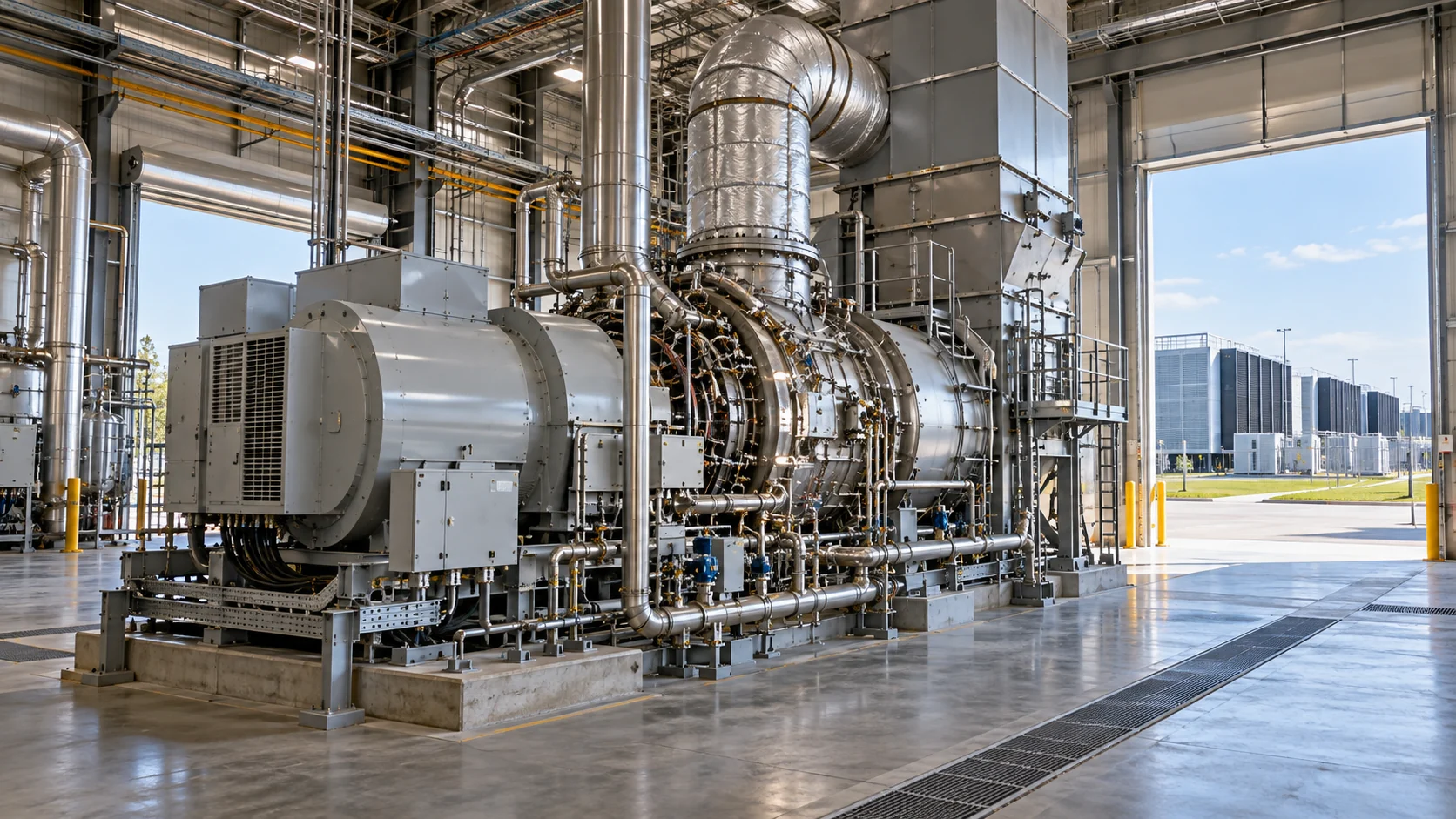
A behind-the-meter turbine generates electricity on the customer side of the utility meter. The data center can run it as its primary supply, use it during constrained hours, or combine it with grid service and batteries. The arrangement can also be structured as a microgrid, with controls that isolate the campus during a utility outage.
A simple-cycle combustion turbine is attractive when speed and flexibility matter. It can start relatively quickly and is useful as a peaking resource, but its fuel efficiency is weaker than a combined-cycle plant. A combined-cycle plant adds a heat-recovery steam generator and steam turbine. That produces more electricity from the same gas, but it adds cost, equipment, water or air-cooling decisions, and construction time.
The distinction matters because a data center has a high and unusually steady load. A peaker built for a few hundred hours per year may be a poor fit if it must run around the clock. Conversely, a fast-start turbine can be valuable as a bridge while the permanent supply is built.
The Energy Information Administration reported in June 2025 that developers planned 18.7 gigawatts of new U.S. combined-cycle capacity through 2028, including 4.3 gigawatts already under construction. EIA also noted that more than half of the 3.3 gigawatts planned for 2026 was already under construction, while much of the 2027 pipeline was not. Those figures describe utility-scale projects, not campus generators, but they show the difference between a named project and equipment that is moving toward operation.
The first constraint is often the gas system
A turbine needs a firm fuel supply, not just a nearby pipeline on a map. The project owner must confirm pressure, delivery capacity, interconnection terms, curtailment rules, and whether the pipeline can support the expected hourly profile during cold weather.
This is especially important in New England and other regions where gas demand rises for heating. The power plant may be able to run in normal conditions and still face fuel constraints on the coldest days. A data center that promises nonstop service cannot treat gas as an assumed input. It needs a supply contract, backup fuel policy where permitted, and a plan for what happens if the pipeline operator curtails deliveries.
Fuel cost is another variable. EIA reported that Henry Hub gas averaged $3.52 per million British thermal units in 2025, 56% above 2024. Northeast hub prices averaged roughly twice 2024 levels. A turbine with a low capital cost can therefore become expensive to run when local gas prices spike.
Efficiency is a financial variable, not a footnote
The heat rate measures how much fuel a generator needs to produce one kilowatt-hour. EIA has reported that newer combined-cycle plants generally have heat rates below 7,000 Btu per kilowatt-hour, while simple-cycle and steam units are typically above 10,000 Btu per kilowatt-hour.
Consider a simplified example. A 100-megawatt turbine running at a 7,000 Btu per kilowatt-hour heat rate consumes about 700 million Btu per hour at full output. At $4 per million Btu, the fuel cost is about $2,800 per hour, before operations, maintenance, emissions costs, and capital recovery. At a 10,000 Btu heat rate, the same output uses about 1,000 million Btu per hour, raising the fuel bill to $4,000 per hour.
These are illustrative calculations, not a forecast. They show why the nameplate megawatt number is not enough. The financial model needs hourly dispatch, expected load factor, heat rate at partial load, start costs, maintenance intervals, fuel transportation, emissions costs, and the cost of purchased grid power.
Permits and community acceptance can set the schedule
A campus turbine is still a power plant. It may need air permits for nitrogen oxides, carbon monoxide, particulate matter, greenhouse gases, and startup or emergency operation. Noise, visible exhaust, water use, and emergency fuel storage can all affect local review.
The fast path is not always the cheapest path. A permit that limits operating hours may undermine the reason for installing the turbine. A requirement for selective catalytic reduction can add cost and water or reagent logistics. Diesel backup generators may exist for reliability but are not automatically an acceptable substitute for a continuous primary supply.
Operators should publish a clear operating envelope: expected annual hours, normal dispatch, emergency dispatch, fuel type, emissions controls, and how the project will respond to grid emergencies. That turns a technical project into a reviewable public commitment.
The prudent model is usually hybrid
The strongest case for campus turbines is often not grid replacement. It is staged power.
Phase one uses temporary or bridge generation to energize an initial building. Phase two adds utility service and perhaps battery storage. Phase three moves the site toward a lower-carbon mix through renewable contracts, firm clean power, or a future nuclear or geothermal resource.
This structure also protects against stranded equipment. If the grid connection arrives early, the turbine can become a resilience and peak-management asset instead of an oversized primary plant. If the connection is delayed, it can keep the site moving.
The key diligence question is simple: what problem is the turbine solving? If it solves a documented interconnection delay and the fuel, permits, and operating costs are underwritten, it can be a practical bridge. If it is being used to make an uncertain site look powered on a slide deck, the risk is much higher.
Sources
- EIA, “Electric generators plan more natural gas-fired capacity after few additions in 2024,” June 11, 2025: eia.gov
- EIA, “Fossil generation could rise with faster-than-expected growth in data center power demand,” March 12, 2026: eia.gov
- EIA, “U.S. wholesale day-ahead electricity prices rose in 2025 with higher natural gas prices,” February 2, 2026: eia.gov
- EIA, “Use of natural gas-fired generation differs in the United States by technology and region,” December 2023: eia.gov
- DOE, “Onsite Energy Program”: energy.gov
BOSSTOX Research articles are drafted with AI assistance and reviewed by our editors before publication. See our editorial standards.

What the TGI Fridays Wind-Down Teaches About Whole-Business Securitization

AI Infrastructure’s Rough Week: Chips Fall 6.7% as Meta Lifts Capex Floor

FERC’s Large-Load Orders: The November 16 Grid Deadline Behind the AI Build-Out

Liquid-Cooling Leak Detection and Reliability

Gas Turbines on Data-Center Campuses

Transformer Lead Times Are Becoming a Data-Center Schedule Risk

GPU Supply Chains: How AI Hardware Gets Made, Moved, and Bottlenecked

Water Use and Dry Coolers: The Tradeoff AI Sites Cannot Avoid
What the TGI Fridays Wind-Down Teaches About Whole-Business Securitization
AI Infrastructure’s Rough Week: Chips Fall 6.7% as Meta Lifts Capex Floor
FERC’s Large-Load Orders: The November 16 Grid Deadline Behind the AI Build-Out
Liquid-Cooling Leak Detection and Reliability
-
 Power & Grid2 weeks ago
Gas Turbines on Data-Center Campuses
-
 Power & Grid2 weeks ago
Transformer Lead Times Are Becoming a Data-Center Schedule Risk
-
 Compute & Silicon2 weeks ago
GPU Supply Chains: How AI Hardware Gets Made, Moved, and Bottlenecked
-
 Cooling2 weeks ago
Water Use and Dry Coolers: The Tradeoff AI Sites Cannot Avoid
-
 Power & Grid1 week ago
Small Modular Reactors: Timelines vs. Headlines
-

 Power & Grid6 days ago
Battery Storage at AI Sites
-

 Explainers2 weeks ago
Explainer: What an AI Inference Stack Actually Does
-

 Explainers2 weeks ago
AI Costs for Small Businesses: A Practical Model Before You Buy GPUs