
Capital & Backlog
Bookings, Billings and Revenue: Three Numbers That Are Easy to Confuse
Bookings, billings and revenue each capture a different moment in a sale. This explainer shows how they relate and why companies report all three.


Companies that sell long-term contracts, from cloud services to data center leases and power equipment, often talk about bookings, billings and revenue. The words sound similar and are sometimes used loosely, but they describe different stages of the same relationship with a customer.
Bookings: the signed deal
A booking is the value of a contract when a customer signs it. If a customer commits to a multi-year agreement, the total contract value may be counted as a booking at signing, even though no service has been delivered and no money has changed hands.
Bookings are not defined by accounting standards, so companies calculate them in different ways. Some count only firm, non-cancelable commitments. Others include options or estimates. That variation makes bookings useful mainly for comparing a company with itself over time.
Billings: the invoice
Billings are the amounts a company invoices customers in a period. A customer might be billed annually in advance, monthly or on delivery of equipment. Billings often roughly equal revenue plus the change in deferred revenue, the money collected or invoiced for services not yet provided.
Billings can move ahead of or behind revenue depending on payment terms, which is why some analysts watch them as an early signal and others treat them cautiously.
Revenue: the earned amount
Revenue is recognized when the company actually delivers what it promised, following accounting rules. For a cloud contract, revenue is typically recognized over time as the service is provided. For equipment, it may be recognized when the product is delivered or as a long-term project progresses.
Revenue is the figure on the income statement and the one subject to the most rigorous accounting standards.
How they fit together
Imagine a customer signs a three-year agreement. The sequence might look like this:
- At signing, the full contract value is counted as a booking and added to backlog or remaining performance obligations
- Each year, the company issues an invoice, which counts as billings
- Each month, as service is delivered, a portion is recognized as revenue
In this example, bookings come first and are largest, billings come in chunks and revenue accrues steadily. Over the life of the contract, all three should converge on the same total, assuming nothing changes.
What to watch for
Because bookings and billings are non-standard, it helps to read how a company defines them. Large single deals can make bookings jump in one quarter. Changes in billing terms can shift billings without any change in underlying demand. Revenue remains the most consistent measure, while bookings and backlog offer a forward-looking view. Reading all three together, along with the definitions, gives the clearest picture of where a company stands with its customers.
This article is general education about how the industry and financial reporting work. It is not investment advice and does not recommend buying or selling any security. For decisions about your own money, talk to a licensed financial advisor.






Capital & Backlog
Why Interest Rates Matter So Much to Data Center Economics
Data centers are long-lived, capital-heavy assets, which makes them sensitive to the cost of borrowing. Here is how interest rates and the cost of capital shape the build-out.
A data center is built with a large amount of money up front and pays off over many years. That basic shape, spend now and earn later, makes the economics of data centers highly sensitive to interest rates. Understanding why helps explain a good deal of the financial commentary about the build-out.
The cost of capital
Every company pays for the money it uses. Lenders expect interest. Shareholders expect a return, even if it is not written in a contract. The blended cost of all those sources is called the cost of capital, often estimated as a weighted average of the cost of debt and the cost of equity.
A project makes economic sense, in broad terms, when the returns it is expected to generate exceed the cost of the capital used to build it. When the cost of capital rises, the bar a project must clear rises with it.
Why long-lived assets are especially sensitive
Money received in the future is worth less than money received today, partly because today’s money could earn interest in the meantime. Finance captures this through a process called discounting. The higher the interest rate used to discount future cash flows, the less those future cash flows are worth today.
Because data centers and power plants produce cash over many years, a change in rates has a large effect on their present value. A modest rise in rates can noticeably reduce what a long-term stream of rent is worth.
Where rates show up
Interest rates affect the build-out in several ways:
- Borrowing costs for construction loans, bonds and project finance
- The returns investors demand from real estate and infrastructure, often discussed as capitalization rates
- The prices of existing data center properties in sales and sale-leasebacks
- The relative attractiveness of building versus leasing capacity
- REIT funding, since REITs rely heavily on raising outside capital
Not the only factor
Rates are important, but they are not destiny. Very large technology companies may fund much of their spending from operating cash flow, making them less dependent on borrowing. Strong demand can support projects even when financing costs are higher. And contracts with built-in rent escalations can help offset some of the impact. Interest rates shift the math; they do not settle it on their own.
Following the connection
When reading about data center financing, it helps to notice whether a deal involves fixed or floating rates, how long the financing lasts and whether it is backed by long-term leases. Central bank decisions and bond market moves often appear in coverage of infrastructure for exactly these reasons. Understanding the link between rates and long-lived assets is useful literacy, not a guide to any individual decision.
This article is general education about how the industry and financial reporting work. It is not investment advice and does not recommend buying or selling any security. For decisions about your own money, talk to a licensed financial advisor.
Capital & Backlog
AI Infrastructure’s Rough Week: Chips Fall 6.7% as Meta Lifts Capex Floor
The chip index lost 6.7% in a day, Meta lifted its 2026 capex floor to $135 billion and 10-year yields sat near 5%. The week in AI infrastructure.
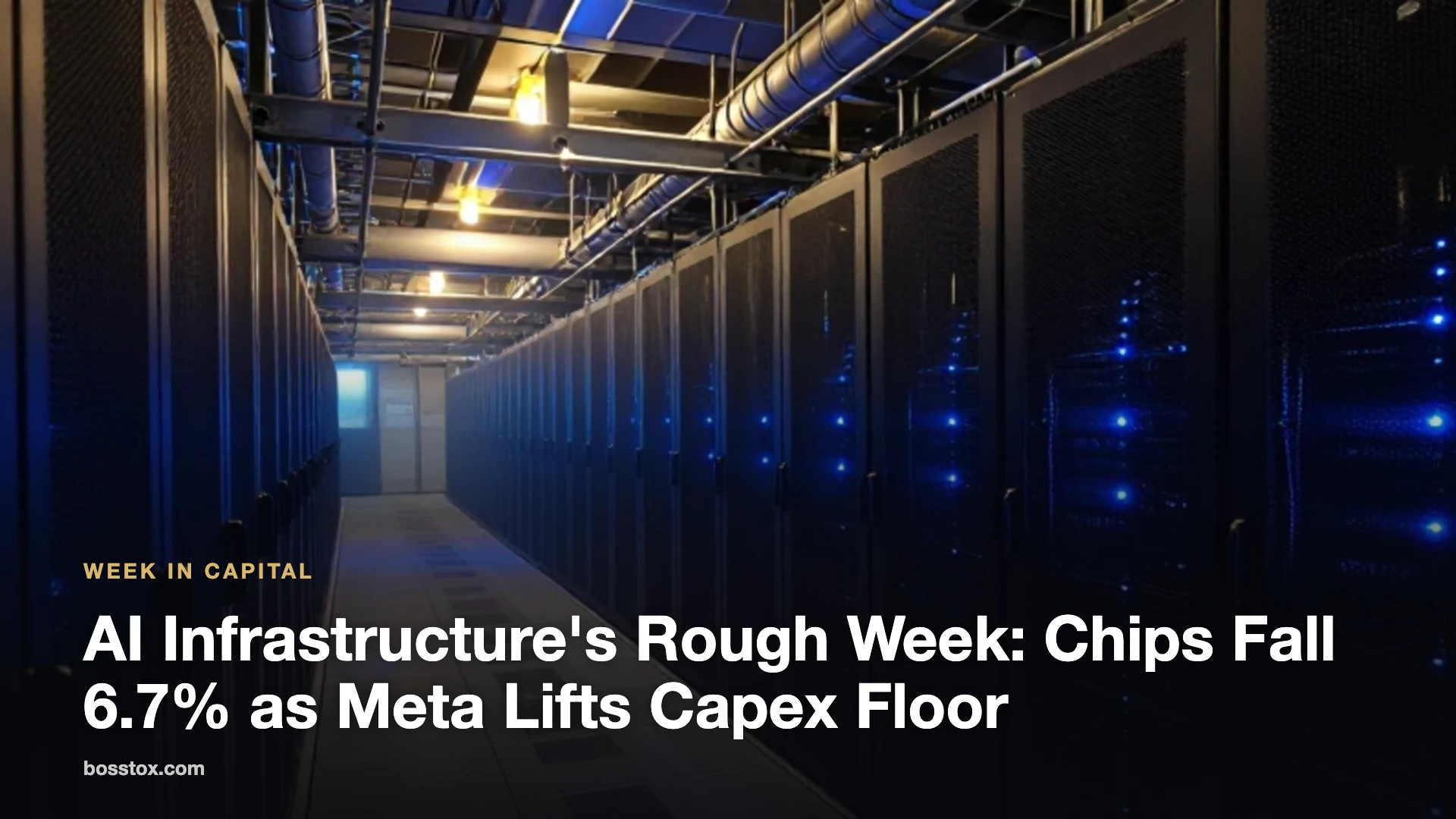
The AI-infrastructure trade had its worst day since June on Thursday, Oct. 22, 2026, when the Philadelphia Semiconductor Index fell 6.7% and the Nasdaq Composite dropped 2.6% after Meta Platforms raised the floor of its 2026 capital budget to $135 billion while reporting its first quarterly cash outflow in more than a decade, and chip-equipment maker Lam Research blamed supply constraints for a softer forecast.
The tape: a flat-looking week that was anything but
The weekly numbers understate the violence. Kitco and Reuters data put the S&P 500 down about 0.5% for the week of Oct. 19-23, the Nasdaq Composite down 0.7% and the Dow Jones Industrial Average up 0.4%. The Associated Press said the S&P 500 recorded its second straight weekly loss. Reuters reported Friday’s closes at 7,629.92 for the S&P 500, down 0.43%, 25,986.95 for the Nasdaq, down 0.08%, and 52,241.55 for the Dow, down 626.43 points or 1.18%.
Inside that range, the market rallied Wednesday, with the Nasdaq up 1.05% to 26,702.86 and the S&P 500 up 0.58% to 7,757.17, according to Kitco, then gave it all back Thursday. The Nasdaq fell 694 points to 26,008.86, its steepest one-day drop since early June, and the S&P 500 lost 1.21% to 7,663.43, Reuters reported. The Philadelphia Semiconductor Index’s 6.7% decline was its largest since June 23; the index is now more than 26% below its June 22 record close even after a 51.5% gain for the year. The S&P 500 is up 11.9% in 2026.
What triggered it: Meta’s cash, Lam’s constraints
Meta reported third-quarter revenue of $64.6 billion, up 26%, net income of $9.8 billion and earnings of $3.83 a share on Wednesday evening, Forbes reported. Capital spending in the quarter was $34.9 billion, and the company raised its full-year 2026 capex guidance to $135 billion to $145 billion from $130 billion to $145 billion. It also announced a two-for-one split that will hand each Class A holder a non-voting Class C share, a structure the company could use to raise capital, and Reuters reported that Meta posted its first quarterly cash outflow in more than a decade because of AI spending. Forbes reported the shares initially rose more than 3% after the release; they fell 7% in Thursday’s regular session.
Lam Research compounded the mood. Chief financial officer Doug Bettinger said the company’s $8.6 billion revenue guidance “would have been a bit higher if not for some near-term supply chain constraints,” Yahoo Finance reported. Sources differ on the damage: Yahoo Finance reported Lam fell as much as 11% intraday, while GuruFocus and Seeking Alpha put the closing loss near 12%. Applied Materials fell 7% and ASML 6% in sympathy. Reuters reported that Intel, AMD, Marvell and Sandisk each lost more than 8%; Yahoo Finance had Broadcom down more than 4%; and Micron fell about 6% while Nvidia closed down 4.4% at $212.21, according to market data compiled by HeyGoTrade. Tesla slipped 3.1% despite positive free cash flow and a cut to its 2026 capital spending plans.
Paul Nolte of Murphy & Sylvest told Reuters, “Investors are starting to realize that there are some holes in the AI story.” On Friday, Man Group’s Kristina Hooper told Reuters, “There is still fallout from the questioning of the AI trade,” and warned that less may be invested in AI data-center construction next year than projected.
The cost of capital is the real story
For BOSSTOX readers, the chip tape matters less than the financing backdrop. The 10-year Treasury yield reached about 5.14% on Tuesday, Kitco reported, then fell to 4.96% late Thursday as money fled equities for bonds before ending Friday at 4.99%, according to the AP. The Federal Reserve, which raised its benchmark rate on Sept. 16 to a range of 3.75% to 4%, meets Oct. 27-28; CME FedWatch pricing cited by Reuters gives a 92% chance of a hold and a 78% chance of a December hike.
The AP put the link plainly: many AI companies have borrowed to fund infrastructure, and high interest rates are making that debt costlier. Angelo Kourkafas of Edward Jones told the AP that “investors appear increasingly focused on the economics of AI.” Meta’s non-voting share class is one answer to that scrutiny, equity rather than debt, and the market’s 7% response suggests how equity holders feel about dilution funding data centers.
Inflation is now part of the capex calculus too. The AP reported Goldman Sachs estimates that the data-center buildout has added about half a percentage point to U.S. inflation by driving up prices for semiconductors and electrical components. Brent crude climbed above $111 a barrel Friday, per the AP, lifting the energy sector to a record and reinforcing the rate outlook that makes long-dated infrastructure projects harder to finance.
Power and cooling: the read-through
Equipment and power names did not escape. Lam’s “supply chain constraints” comment is a reminder that the bottleneck has moved upstream from GPUs to the tools, substrates and components that make them, and the same is true of transformers, switchgear and chillers. Vertiv, the thermal and power specialist, reports third-quarter results before the market opens Wednesday, Oct. 28, with a call at 11 a.m. Eastern, according to its investor relations site. Its backlog commentary will be the week’s cleanest signal on whether hyperscaler capex is translating into orders for cooling and power gear or stalling at the planning stage. Nvidia’s modular AI-factory reference design, unveiled Oct. 21 and covered earlier this week on BOSSTOX, names power and cooling vendors as launch partners, which raises the stakes for Vertiv’s guidance.
The calendar
Next week is the densest of the quarter. Alphabet, Microsoft and Amazon all report, and Reuters noted that roughly a third of S&P 500 companies will release results, with capital-spending forecasts under the microscope. LSEG data cited by Reuters put third-quarter S&P 500 earnings growth on track for more than 32%, and 83% of the 111 companies that had reported by Thursday beat expectations. The Fed decision lands Wednesday at 2 p.m. Eastern, the September PCE inflation report follows Thursday morning, and the Nov. 3 midterm elections are the week after. The University of Michigan’s consumer sentiment index sat at 48.0 in October, near a record low, Kitco reported, a reminder that the consumer side of the economy is not matching the capex side.
The BOSSTOX Take
Thursday was not a verdict on AI demand; Meta grew revenue 26% and raised its spending floor. It was a verdict on how that spending is funded. When a company with $64.6 billion in quarterly revenue runs cash-flow negative and creates a non-voting share class, equity investors are being asked to finance infrastructure that debt markets, at 5% Treasury yields, price expensively. The backlog data from Vertiv and the hyperscalers next week will show whether the buildout is slowing or simply getting more expensive to finance. BOSSTOX reports on AI infrastructure and does not provide investment advice.
What it means for you
- Operators and builders: lenders are repricing data-center debt against a 10-year yield near 5%; expect tighter covenants and higher spreads on new project financing.
- Suppliers: Lam’s comment confirms upstream constraints; power, cooling and substrate vendors with delivery slots in 2027 hold pricing power.
- Watch Vertiv on Oct. 28 and the hyperscaler capex lines next week for backlog growth, not just headline spending; the two can diverge.
- The Fed’s Wednesday statement and Thursday’s PCE report set the rate path that governs every long-dated infrastructure model.
- Equity-funded capex, as in Meta’s Class C plan, shifts risk from bondholders to shareholders; expect more such structures if yields stay high.
Test yourself
1. How much did the Philadelphia Semiconductor Index fall on Oct. 22, and how far is it from its record?
Answer: It fell 6.7%, its largest drop since June 23, and sits more than 26% below its June 22 record close despite a 51.5% gain for the year.
2. What did Meta change in its 2026 capital spending guidance?
Answer: It raised the range to $135 billion to $145 billion from $130 billion to $145 billion, lifting the floor by $5 billion.
3. Why does Meta’s stock split matter for infrastructure financing?
Answer: The split issues non-voting Class C shares that the company could use to raise capital, a way to fund AI buildout with equity rather than debt.
4. When does Vertiv report third-quarter results?
Answer: Before the market opens on Wednesday, Oct. 28, 2026, with a conference call at 11 a.m. Eastern.
Discussion
- Is a hyperscaler that funds data centers with non-voting equity more or less committed to the buildout than one that borrows?
- If supply constraints are moving upstream to tools and substrates, which parts of the power and cooling chain are next?
- Should the Fed’s rate path, rather than GPU demand, be the primary variable in an AI-infrastructure capacity model for 2027?
From the network
- Boston Made Reader — every story from the family in one free reading app.
- Lumo — live gold, silver and platinum prices, a melt-value calculator and local dealer quotes.
- Boston Made Newsroom — company news and announcements from Boston Made, Inc.
Sources
- Associated Press — Wall Street loses ground under pressure from rising oil prices
- Associated Press — Inflation worsened last month to 3.7% as midterm elections near
- Reuters — Nasdaq plunges 2.6% as AI spending fears spark tech selloff
- Reuters — Dow, S&P 500 fall, tech steadies to end rocky week
- Reuters — Gold set for steep weekly loss as rising oil prices bolster Fed rate hike bets (Fed pricing)
- Forbes — Meta posts $64 billion in revenue and announces stock split in Q3 earnings
- Yahoo Finance — Chip stocks fall as equipment maker Lam Research cites ‘supply chain constraints’
- GuruFocus — Lam Research shares drop 12% after earnings despite beat
- Seeking Alpha — Lam Research retreats 12% amid cautious guidance, China revenue drop
- The Motley Fool — Why Intel stock fell today
- HeyGoTrade — Nvidia stock news: NVDA falls 4.4% to $212.21 (Oct. 22 session)
- Kitco — Gold gains as Treasury yields stabilize, Nasdaq surges (PM report, Oct. 21)
- Kitco — Weekly index moves and Michigan sentiment (PM report, Oct. 23)
- USAGOLD — Daily market report, Oct. 20, 2026 (10-year yield)
- Vertiv — Announces date of third quarter 2026 earnings release and conference call
Capital & Backlog
What the TGI Fridays Wind-Down Teaches About Whole-Business Securitization
TGI Fridays’ operating company is being liquidated while its brand and 69 franchised U.S. units carry on. What the securitization saga teaches investors.
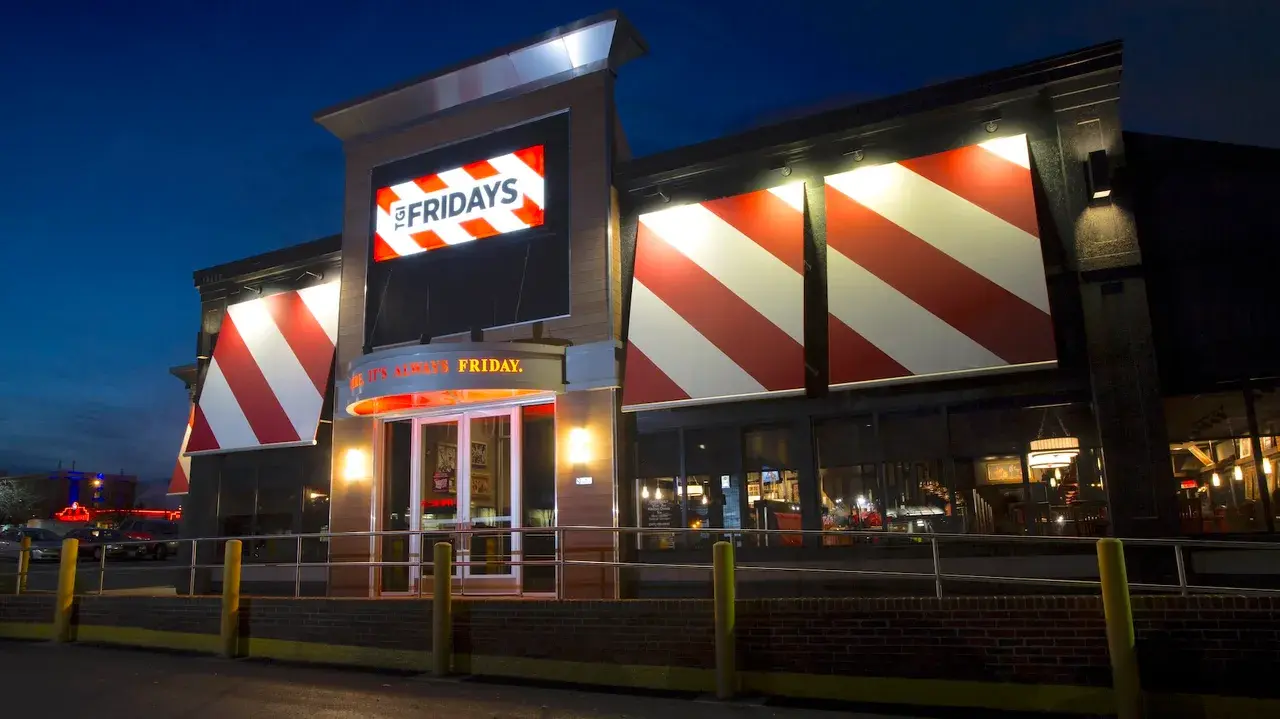
The liquidation of TGI Friday’s Inc., approved by a Texas bankruptcy judge in July 2026, ends the company that ran the chain for decades while the brand, its royalty stream and 69 franchised U.S. restaurants carry on under new management, a split that shows how a whole-business securitization is built to work and who absorbs the losses when it does.
How the structure was built
A whole-business securitization moves a franchisor’s most dependable cash flows, its franchise royalties, license fees and intellectual property, into special-purpose entities designed to be insulated from the operating company’s bankruptcy. Those entities issue bonds against the cash flows. The operating company stays outside, earning a management fee for collecting royalties and supporting franchisees. Domino’s and Subway are among the brands that have used the structure, Restaurant Business noted.
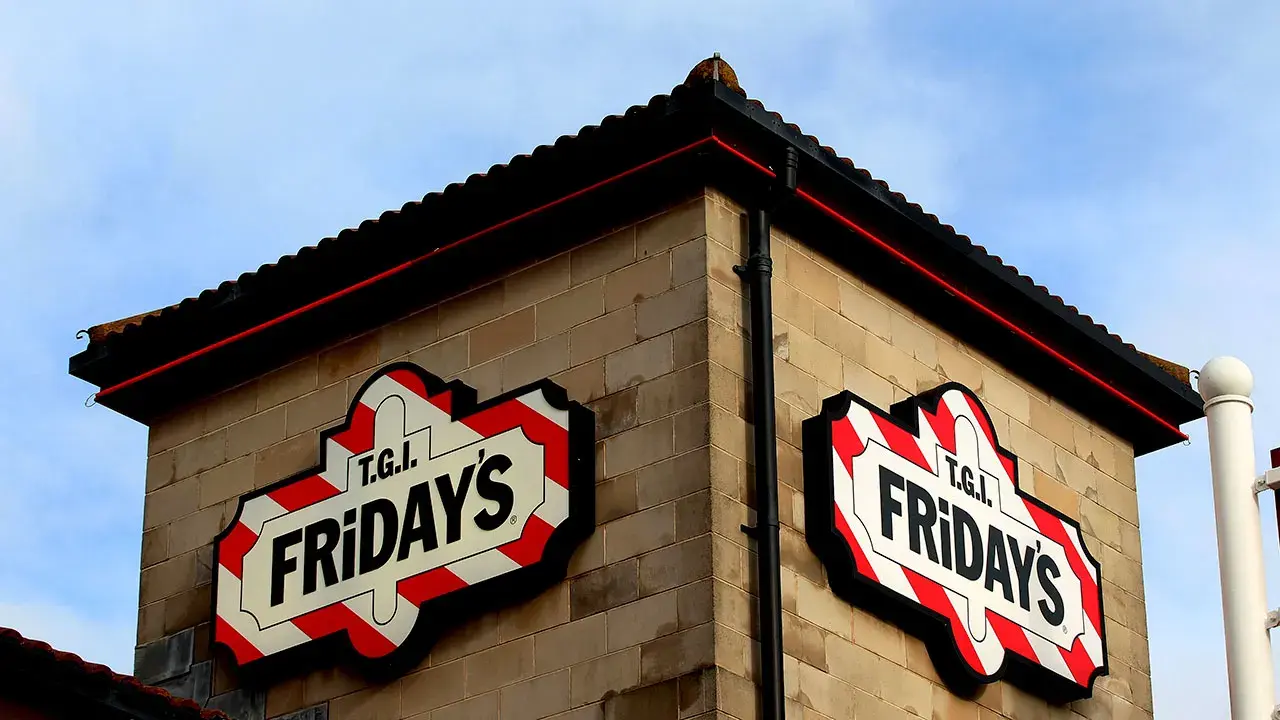
TGI Fridays joined them in February 2017 with TGIF Funding LLC Series 2017-1, three years after Carlson sold the chain to Sentinel Capital Partners and TriArtisan Capital in a deal valued at more than $800 million including debt, according to CNBC and FSR magazine. Kroll Bond Rating Agency rated the 2017 notes BBB and S&P assigned BBB-, according to Inside Mortgage Finance. The collateral included license agreements, existing and future franchise agreements, royalties on company-operated restaurants and intellectual property, KBRA said in November 2024.
The deal’s size is reported differently. Inside Mortgage Finance put it at $450 million; American Banker’s Asset Securitization Report put the original issuance at $425 million, made up of a term note and a variable funding note; and Restaurant Dive and The Dallas Morning News described a $375 million bond, the size of the main term note.
The triggers that tightened
Securitizations of this kind contain early-warning triggers, and TGI Fridays tripped one in mid-2020. Trailing 12-month systemwide sales fell to $1.4 billion, below a $1.5 billion floor, putting the notes into rapid amortization, American Banker reported. KBRA said the deal stayed in rapid amortization from the second quarter of 2020 onward. In that state, cash left after senior fees goes to retire the notes before the operator sees any.
Coverage eroded steadily. American Banker reported a debt service coverage ratio of about 2.2 times at issuance and about 1.6 times in 2020. KBRA put it at 1.06 times in the third quarter of 2024 and rated the remaining notes B, down from BBB at issuance. Some principal was retired early, including with proceeds from the sale of permanent retail licensing rights to Kraft Heinz in 2024, Restaurant Business and The Dallas Morning News reported. By November 2024, KBRA said, only the Class A-2 note remained outstanding, at a note factor of about 36.7 percent.
The manager termination
On Sept. 3, 2024, the securitization’s control party declared a manager termination event and removed TGI Fridays as manager, KBRA said. The trustee, Citibank, issued the termination, according to Restaurant Business and The Dallas Morning News. FTI Consulting, the back-up manager, took over royalty collection and franchise support. Kroll described it as the first manager termination in a whole-business securitization since the 2008 financial crisis, Restaurant Business and Restaurant Dive reported.
The trigger was not a missed payment. Interest on the notes continued to be paid on time, KBRA and Restaurant Dive reported. KBRA said the company failed to deliver a required report from independent auditors or the back-up manager by the deadline. S&P, as cited by Restaurant Business, pointed to several factors, including a roughly $2 million overpayment of management fees that had already been spent on overdue vendor bills.
The consequences were immediate. Hostmore, the U.K. franchisee that had agreed to a $220 million all-share combination, abandoned the deal on Sept. 9 after the American group lost control of TGIF Funding, Restaurant Online reported, and entered administration on Sept. 18.
Chapter 11 for the operator only
TGI Friday’s Inc. filed for Chapter 11 on Nov. 2, 2024, in the Northern District of Texas. The case covered 39 company-run restaurants. The franchised restaurants and the brand’s intellectual property, held by a separate franchisor entity, were not part of it, the Associated Press and Nation’s Restaurant News reported.
The operator’s own funded debt was small next to the securitization: Restaurant Business reported $37 million at filing, while Bloomberg Law put it at about $47 million. A larger consumer-facing obligation was $49.7 million in outstanding gift cards, which the judge allowed the company to keep honoring, according to Fortune and PaymentsJournal.
The company then sold or closed its stores. MERA Corp. paid $34.5 million for nine restaurants in January 2025, FSR and Restaurant Business reported. Of the 39 company-owned restaurants, 28 went to franchisees and 11 closed, according to the franchise disclosure document summarized by Fast Company. On July 23, 2026, Judge Stacey G. Jernigan approved a consensual liquidating plan, Bloomberg Law reported; Nation’s Restaurant News dated the confirmation July 24. A post-confirmation trust will distribute remaining assets to creditors, and the debtors’ counsel, Foley & Lardner, said all major creditor groups supported the plan.
Where the brand landed
The brand is now run by Sugarloaf, the group led by former chief executive Ray Blanchette, who returned in 2025. NRN and Fast Company describe Sugarloaf as the owner. The U.K. administrator Interpath, in a January 2026 announcement, called it “the manager and custodian of the worldwide TGI Friday brand.” Public reporting reviewed for this article does not detail how the securitization noteholders’ claims were resolved or what they recovered.
Blanchette has described the company as operating under a debt-free structure, Restaurant Dive reported in 2025. The U.S. system is now entirely franchised, with 69 restaurants listed in October, down from 269 at the end of 2023. The amended disclosure document projects no U.S. openings in 2026, while a Sept. 29 development deal with Bliss Bites LLC calls for five New York restaurants over three years.
The BOSSTOX Take
TGI Fridays is the clearest recent case of a whole-business securitization doing exactly what it promised bondholders and little more. The royalty stream kept paying interest through a manager termination and a Chapter 11 filing, and the brand survived intact. The operating company, which carried the restaurants, the leases, the gift cards and the employees, absorbed the losses. Two lessons stand out. First, the binding constraints were contractual and administrative rather than a payment default: a sales trigger in 2020 diverted cash away from the operator for four years, and a reporting lapse or fee dispute was enough to hand control to a back-up manager. Second, asset-light does not mean risk-light. The structure concentrates value in the brand and pushes fragility onto the operator and franchisees, whose closures shrink the royalty base the bonds depend on. For investors, the useful questions are less about headline leverage and more about who controls the cash, what trips the triggers and how healthy the franchisees are.
This article is for informational purposes only and is not investment advice.
What it means for you
- Track the triggers: in any securitized franchisor, compare systemwide sales with rapid-amortization thresholds and the debt service coverage ratio with cash-trap levels, which rating agencies disclose.
- Watch the manager: fee calculations and reporting deadlines matter, because a compliance failure can shift control to a back-up manager while payments are current.
- Count units, not just royalties: franchise closures, like the nine in the TGI Fridays system through September 2026, shrink the collateral.
- Know where the brand lives: when intellectual property sits in a separate entity, an operating-company bankruptcy can leave the brand untouched and the operator’s creditors with little.
- Separate stabilization from growth: a fully franchised structure can stop the bleeding, but growth targets still have to show up in unit openings.
Test yourself
1. What pushed the TGI Fridays securitization into rapid amortization in 2020?
Answer: Trailing 12-month systemwide sales fell to $1.4 billion, below a $1.5 billion threshold, American Banker reported.
2. Who became successor manager after the September 2024 termination?
Answer: FTI Consulting, which had been the deal’s back-up manager.
3. Was the manager termination caused by missed interest payments?
Answer: No; interest kept being paid on time, and KBRA cited a late required report while S&P cited factors including a fee overpayment.
4. Which entity is being liquidated under the July 2026 plan?
Answer: TGI Friday’s Inc., the old operating company; the brand and its franchised restaurants continue under Sugarloaf.
Discussion
- Did the securitization protect the TGI Fridays brand, or hasten the decline of the company that ran it?
- Should a back-up manager be able to take control over a reporting failure while bond payments are current?
- How should investors value an asset-light franchisor whose franchisee count is still shrinking?
From the network
- Boston Made Reader — every story from the family in one free reading app.
- Boston Made Newsroom — regional business and economy coverage, including the TGI Fridays closures in Massachusetts.
- Kingswell Strategic Ventures — strategy, ventures and holdings.
Sources
- Associated Press (via The Intelligencer) — TGI Fridays files for bankruptcy protection as sit-down restaurant struggles continue
- KBRA (via Business Wire) — KBRA comments on TGI Fridays Chapter 11 bankruptcy filing
- Inside Mortgage Finance — TGI Friday’s brings first whole-business securitization of 2017 with $450 million deal
- American Banker (Asset Securitization Report) — TGI Friday’s whole-biz notes downgraded following rapid-amortization trigger
- Restaurant Business — TGI Fridays loses control of most of its assets
- The Dallas Morning News — Dallas-based TGI Fridays management loses control of much of the company’s assets
- Restaurant Dive — TGI Fridays acquisition falls through, bondholders seize assets
- Restaurant Dive — Why TGI Fridays filed for bankruptcy
- Restaurant Online — TGI Fridays owner Hostmore files for administration
- Nation’s Restaurant News — TGI Fridays files for Chapter 11 bankruptcy
- CNBC — Carlson sells TGI Fridays, reportedly for $800M
- FSR magazine — Extraordinary conditions sink TGI Fridays’ $380M sale
- Restaurant Business — TGI Fridays sells 19 restaurants out of bankruptcy
- Bloomberg Law — TGI Friday’s dining chain approved for bankruptcy wind-down plan
- Fortune — TGI Fridays gift cards in Chapter 11
- PaymentsJournal — After the TGI Fridays bankruptcy, a battle over gift cards
- FSR magazine — Former TGI Fridays CEO Ray Blanchette tapped to manage chain’s franchised restaurants
- Fast Company — TGI Fridays store closures: updated list as footprint continues to shrink
- Nation’s Restaurant News — TGI Fridays liquidation plan approved as Chapter 11 winds down
- Foley & Lardner — Foley secures consensual Chapter 11 plan confirmation for TGI Friday’s
- Interpath Advisory — Majority of TGI Friday restaurants across the UK rescued via pre-pack deal
- Restaurant Dive — TGI Fridays CEO says the brand is ready to grow again post-bankruptcy
- FSR magazine — TGI Fridays’ U.S. comeback gains momentum
- PR Newswire — TGI Fridays signs landmark U.S. development agreement

The BOSSTOX App: Markets and the AI Build-Out on iPhone, iPad and Apple Watch

AI Server Rack Power Density, 2024-2027
The Life Cycle of a Data Center: Buildings Last Decades, Servers Do Not

Custom AI ASICs vs. GPUs

Gas Turbines on Data-Center Campuses

Transformer Lead Times Are Becoming a Data-Center Schedule Risk

GPU Supply Chains: How AI Hardware Gets Made, Moved, and Bottlenecked

Battery Storage at AI Sites
The BOSSTOX App: Markets and the AI Build-Out on iPhone, iPad and Apple Watch
AI Server Rack Power Density, 2024-2027
The Life Cycle of a Data Center: Buildings Last Decades, Servers Do Not
Custom AI ASICs vs. GPUs
-
 Power & Grid2 weeks ago
Gas Turbines on Data-Center Campuses
-
 Power & Grid2 weeks ago
Transformer Lead Times Are Becoming a Data-Center Schedule Risk
-
 Compute & Silicon3 weeks ago
GPU Supply Chains: How AI Hardware Gets Made, Moved, and Bottlenecked
-
 Power & Grid2 weeks ago
Battery Storage at AI Sites
-
 Cooling4 weeks ago
Water Use and Dry Coolers: The Tradeoff AI Sites Cannot Avoid
-

 Explainers1 month ago
Explainer: What an AI Inference Stack Actually Does
-

 Explainers1 month ago
AI Costs for Small Businesses: A Practical Model Before You Buy GPUs
-
 Compute & Silicon3 weeks ago
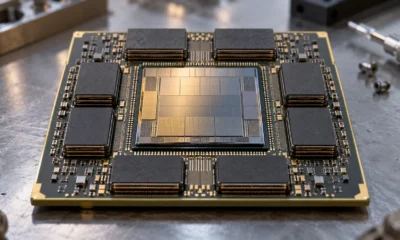
HBM Is a Bottleneck Because AI Memory Is a Stack, Not a Chip






