
Capital & Backlog
How to Read an Equipment Maker’s Backlog
A large backlog can signal demand and future revenue, but its quality depends on customer commitments, delivery timing, cancellation rights, margin and the company’s ability to execute.

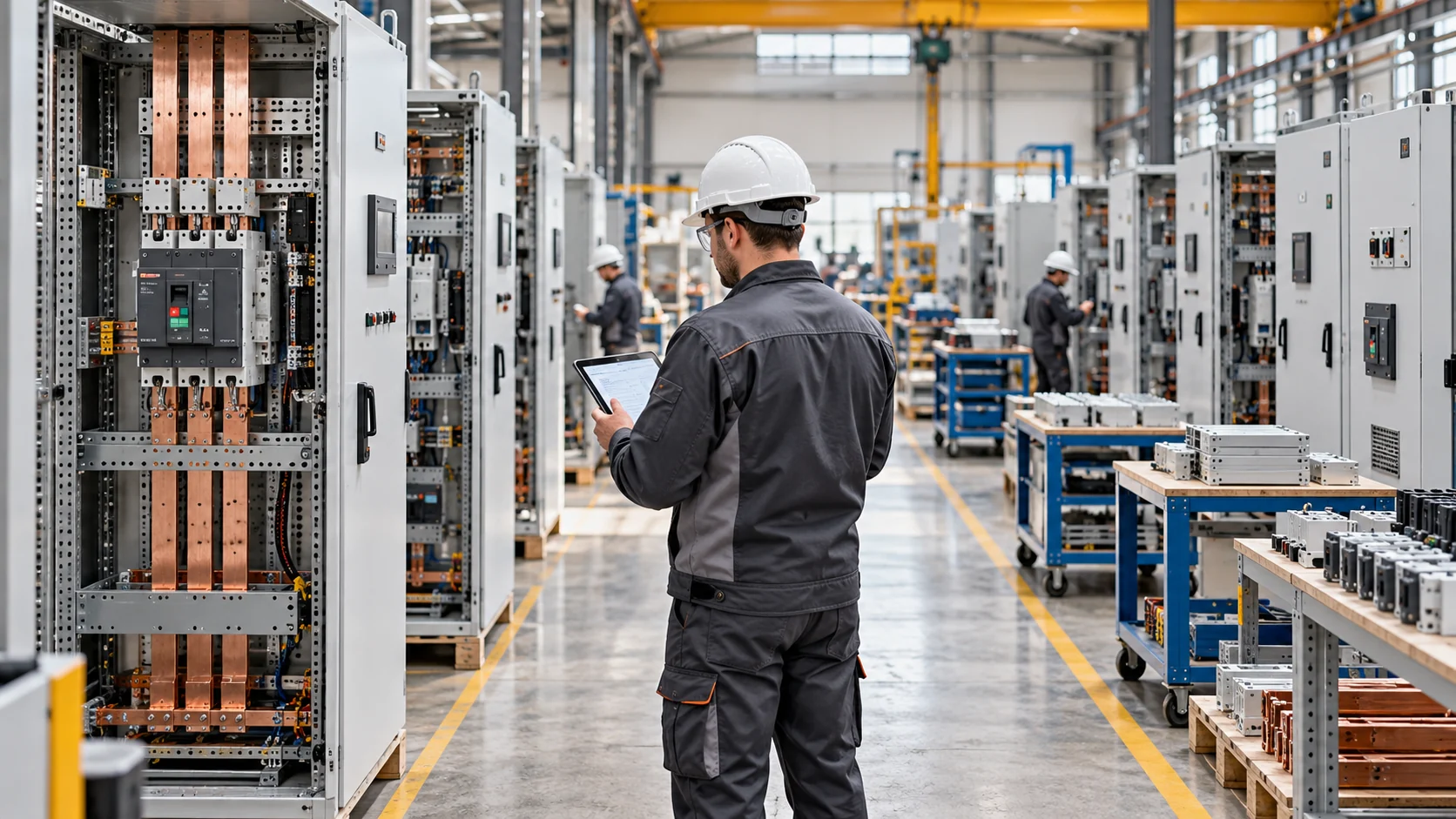
Backlog is not revenue
Equipment makers serving data centers often report backlog. It is tempting to treat that number as a forecast of sales, but backlog is a contract and scheduling measure, not a guarantee of recognized revenue.
Backlog normally represents orders received but not yet delivered or recognized. The definition varies by company and segment. One company may include firm purchase orders that ship within a quarter. Another may include multi-year projects, service agreements or orders that still depend on customer release dates.
The first rule is to read the definition before reading the number.
Eaton’s example
Eaton’s 2025 annual report reported 2025 backlog of $13.246 billion versus $10.141 billion in 2024, with a 31% reported increase and a 19% organic change in backlog. Eaton also reported a 1.2 book-to-bill ratio in the comparison table.
Those figures show strong order momentum, but they do not mean Eaton will recognize $13.246 billion of revenue immediately. The company must make, deliver and install the products. The order mix matters: a backlog of short-cycle electrical components converts differently from a backlog of large switchgear, data-center power systems or long-term services.
What makes backlog high quality
A high-quality backlog usually has:
- Firm customer orders.
- Clear product specifications.
- Deposits or other evidence of commitment.
- Defined delivery windows.
- Few cancellation rights.
- Pricing that protects margin.
- Access to the components and labor needed to deliver.
- A customer with financing and construction readiness.
A lower-quality backlog may include non-binding letters, orders subject to final engineering, projects waiting for permits, customer options, or orders that can be delayed without meaningful penalty.
Not every company discloses all of those details. The analyst’s job is to look for clues in the annual report, earnings call and risk factors.
Backlog and book-to-bill
Book-to-bill compares new orders, or bookings, with revenue. A ratio above 1.0 means orders exceeded revenue during the period. It can indicate demand is growing faster than the company is shipping.
But book-to-bill is a flow measure. Backlog is a stock measure. A company can have a high book-to-bill ratio and still have a backlog that is difficult to convert if capacity, labor or customer projects are constrained.
The best analysis combines bookings, backlog, revenue, gross margin, delivery dates and cancellations. A rising backlog with falling delivery or margin can mean the company is taking orders faster than it can execute them.
Timing and mix
Ask when the backlog is expected to convert. Some companies give a percentage expected within the next twelve months. Others provide short-cycle and long-cycle categories. If the company does not provide a conversion schedule, use its shipment lead times, project descriptions and segment commentary to build a cautious range.
Backlog mix also matters. A large order for a standardized component may carry a different margin and cancellation profile than a customized electrical system. A data-center project may include equipment that is built to a customer’s exact voltage, enclosure, protection and software requirements. Customization can support pricing but make a canceled order harder to redeploy.
Margin is the reality check
Backlog can grow while profitability weakens. Commodity inflation, expedited freight, overtime, warranty work and engineering changes can consume the expected margin. An equipment maker can also book orders at prices that later prove uneconomic if the contract does not include escalation protection.
Read gross margin, operating margin and margin commentary alongside backlog. If backlog grows 30% but margin falls, ask whether the company is buying volume with price or absorbing execution cost.
Capacity is part of backlog quality
An equipment manufacturer may have a strong order book but insufficient factory capacity. The company may invest in new plants, add shifts or outsource production. Each response has a timeline and a yield risk.
For data-center power equipment, component shortages can delay delivery even when the factory has open floor space. Transformers, switchgear, busway, breakers, power electronics and cooling equipment can have different constraints. The order backlog does not tell you which component is the critical path unless management says so.
Cancellations and customer concentration
The annual report should describe cancellation rights and customer concentration. A backlog tied to a small number of large hyperscalers may have high revenue potential but also high exposure to one customer’s construction schedule.
Watch for language about push-outs, project rephasing, order deferrals and changes in customer capital spending. A cancellation does not always appear as a dramatic headline. It may show up as a lower backlog conversion rate or a change in expected revenue timing.
A practical reading method
Use a five-question sequence:
- What exactly is included in backlog?
- How much is firm, scheduled and expected to ship within twelve months?
- What is the mix by product, customer and geography?
- What are the cancellation, pricing and margin protections?
- Can the company produce and deliver it?
Then compare the answers with external demand. If data-center construction is expanding but the company’s backlog is flat, it may be losing share or hitting capacity. If backlog rises faster than factory investment, the delivery risk may be increasing.
BOSSTOX takeaway
Backlog is valuable because it can show future work before it becomes revenue. It is dangerous because the single number hides timing, quality and execution risk.
A serious equipment analysis reports backlog, bookings, book-to-bill, conversion period, margin, cancellation exposure and production capacity together. The question is not “How big is the backlog?” It is “How much of it can become profitable, delivered equipment on schedule?”
A backlog table can also hide customer acceptance. In project equipment, revenue may not be recognized when the order is booked or when the factory ships. Installation, site acceptance testing or customer sign-off may still be required. A backlog that is technically firm can therefore convert into cash more slowly than a short-cycle product order.
Use backlog as a map of future work, then test the map against factory output, working capital, receivables and delivery commentary. That combination reveals whether demand is turning into shipped equipment or only accumulating in the order book.
Sources
- Eaton, 2025 Annual Report, backlog and book-to-bill data: eaton.com
- U.S. Securities and Exchange Commission, Core Scientific 2025 filing, operating metric disclosure example: sec.gov
- U.S. Securities and Exchange Commission, data-center contracted portfolio definitions: sec.gov
- U.S. Department of Energy, “Strengthening America’s Grid Supply Chain,” 2026: energy.gov
BOSSTOX Research articles are drafted with AI assistance and reviewed by our editors before publication. See our editorial standards.
Capital & Backlog
Twenty Minutes, $6.36 Billion: Inside the Binance Heist and What It Means for Everyone Who Holds Assets on an Exchange
On the evening of October 29, wallets belonging to the world’s largest crypto exchange were drained across ten blockchains in roughly twenty minutes. Investigators attribute it to North Korea’s TraderTraitor unit. BOSSTOX walks through what happened, what has been frozen, and the questions it raises for custody, insurance and the exchanges themselves.
Late on Thursday, October 29, 2026, money started leaving Binance. Not a little. Blockchain forensics firm TRM Labs says an attacker moved roughly $6.36 billion out of Binance wallets on ten blockchains, most of it in about twenty minutes. By Friday morning the world’s largest cryptocurrency exchange had suspended deposits and withdrawals, three separate analytics firms had pointed at North Korea, and the industry was in a race to freeze whatever it could before the money disappeared into mixers and over-the-counter desks.
It is, by a wide margin, the largest theft in the history of digital assets. The previous record, the $1.5 billion taken from Bybit in February 2025, is now a footnote at roughly a quarter of the size.
What happened, as far as anyone knows
Binance’s first statement, posted late Thursday, said an initial investigation pointed to an engineer’s laptop. Access to that machine let the attacker reach a service container and submit unauthorized withdrawal transactions. By Friday the company said its investigation had found additional points of breach, which is a careful way of saying the laptop was a door, not the whole story.
Mark Karpeles, who ran the Mt. Gox exchange before its 2014 collapse, told Reuters the attackers most likely obtained signing keys for at least two Binance wallets. That squares with what the forensics firms describe: signatures gathered in advance, staging that began well before the theft, and then everything executed in a single burst. Funds left wallets on Ethereum, Bitcoin, Tron, Solana, the XRP Ledger and others at nearly the same moment.
Binance CEO Richard Teng said the company’s technology and security teams were still deep in the investigation on Friday. Changpeng Zhao, the co-founder who stepped down as CEO in 2023, said he expected user funds to be protected.
Who did it
TRM Labs attributes the attack, with what it calls high confidence, to TraderTraitor, a North Korean state-sponsored unit that focuses almost entirely on stealing cryptocurrency from large companies and exchanges. Chainalysis reached the same conclusion independently. Elliptic noted that some of the stolen funds landed in a wallet used in a $351 million attack on the exchange Bitget earlier this year.
The pattern matters because it is a pattern. The FBI named the same group for the Bybit theft. TRM points to a KelpDAO hack in April 2026 with matching fingerprints: small Tornado Cash withdrawals used to fund an operator wallet, long preparation, then a fast exit. North Korea has been running this playbook since at least 2017, when its hackers hit four South Korean exchanges. Chainalysis and Elliptic estimate the regime’s hackers had stolen around $6 billion in total from 2017 through 2025. In one night they roughly doubled it.
How much is actually gone
Less than the headline, and this is the part worth watching. Security researchers say about half the stolen value was frozen as it moved across chains, because issuers of stablecoins and other centrally controlled tokens can and did blacklist addresses in real time. Binance said Friday it had begun recovering affected assets and was working with law enforcement and the forensics firms to trace more.
The other half is the hard part. Bitcoin and Ether cannot be frozen by an issuer. The attackers will try to split it, mix it, bridge it and eventually convert it through over-the-counter brokers in jurisdictions that do not ask questions. That process took the Bybit thieves weeks, and a large share of that money was never recovered.
What this means for exchanges, custody and the people who use them
Three things, in order of how directly they touch you.
Not your keys, not your coins, again. Every large exchange theft produces the same lesson and most people ignore it because exchanges are convenient. Assets you leave on a platform are an unsecured claim on that platform. Binance says user funds are safe, and its size makes that plausible, but the statement is a promise from a company, not a property of the asset.
Insurance will not save anyone. Most crime and cyber policies exclude stolen cryptocurrency outright. Crypto-specific coverage exists but is small, expensive and written by a handful of specialist underwriters. Exchanges self-insure through reserve funds, and a reserve fund sized for a $100 million incident is not sized for $6 billion.
The attack surface was a person, not a protocol. This was not a flaw in a blockchain. It was a compromised employee device, obtained signing keys and an internal service that trusted them. That is a corporate security failure of the kind that hits banks, hospitals and defense contractors, and it will push exchanges toward the same controls those industries adopted after their own breaches: hardware-isolated signing, multi-party approval with human delays, and treating every engineer’s laptop as hostile.
The BOSSTOX view
We cover the AI build-out: power, cooling, chips, networks and the capital behind them. This story belongs here for a simple reason. Both industries are racing to move enormous value through systems built faster than they have been hardened, and both are discovering that the weakest component is almost always operational, not technical. The forensics and security firms that traced this money in real time, TRM, Chainalysis, Elliptic and their peers, are the picks-and-shovels of digital finance in the same way the cooling and power companies are for AI. When the headline is a disaster, the quiet businesses that make the disaster survivable are where the durable demand sits.
Hackers stole roughly $2.7 billion in crypto across all of 2025, according to TRM’s 2026 Crypto Crime Report. One exchange lost more than twice that in a single evening. Whatever you believe about digital assets, the arithmetic of this week deserves your attention.
BOSSTOX publishes research and explainers. Nothing here is investment advice. Figures are drawn from public statements by Binance and from TRM Labs, Chainalysis and Elliptic as reported October 30–31, 2026, and may change as the investigation continues.
Capital & Backlog
Why Interest Rates Matter So Much to Data Center Economics
Data centers are long-lived, capital-heavy assets, which makes them sensitive to the cost of borrowing. Here is how interest rates and the cost of capital shape the build-out.
A data center is built with a large amount of money up front and pays off over many years. That basic shape, spend now and earn later, makes the economics of data centers highly sensitive to interest rates. Understanding why helps explain a good deal of the financial commentary about the build-out.
The cost of capital
Every company pays for the money it uses. Lenders expect interest. Shareholders expect a return, even if it is not written in a contract. The blended cost of all those sources is called the cost of capital, often estimated as a weighted average of the cost of debt and the cost of equity.
A project makes economic sense, in broad terms, when the returns it is expected to generate exceed the cost of the capital used to build it. When the cost of capital rises, the bar a project must clear rises with it.
Why long-lived assets are especially sensitive
Money received in the future is worth less than money received today, partly because today’s money could earn interest in the meantime. Finance captures this through a process called discounting. The higher the interest rate used to discount future cash flows, the less those future cash flows are worth today.
Because data centers and power plants produce cash over many years, a change in rates has a large effect on their present value. A modest rise in rates can noticeably reduce what a long-term stream of rent is worth.
Where rates show up
Interest rates affect the build-out in several ways:
- Borrowing costs for construction loans, bonds and project finance
- The returns investors demand from real estate and infrastructure, often discussed as capitalization rates
- The prices of existing data center properties in sales and sale-leasebacks
- The relative attractiveness of building versus leasing capacity
- REIT funding, since REITs rely heavily on raising outside capital
Not the only factor
Rates are important, but they are not destiny. Very large technology companies may fund much of their spending from operating cash flow, making them less dependent on borrowing. Strong demand can support projects even when financing costs are higher. And contracts with built-in rent escalations can help offset some of the impact. Interest rates shift the math; they do not settle it on their own.
Following the connection
When reading about data center financing, it helps to notice whether a deal involves fixed or floating rates, how long the financing lasts and whether it is backed by long-term leases. Central bank decisions and bond market moves often appear in coverage of infrastructure for exactly these reasons. Understanding the link between rates and long-lived assets is useful literacy, not a guide to any individual decision.
This article is general education about how the industry and financial reporting work. It is not investment advice and does not recommend buying or selling any security. For decisions about your own money, talk to a licensed financial advisor.
Capital & Backlog
AI Infrastructure’s Rough Week: Chips Fall 6.7% as Meta Lifts Capex Floor
The chip index lost 6.7% in a day, Meta lifted its 2026 capex floor to $135 billion and 10-year yields sat near 5%. The week in AI infrastructure.
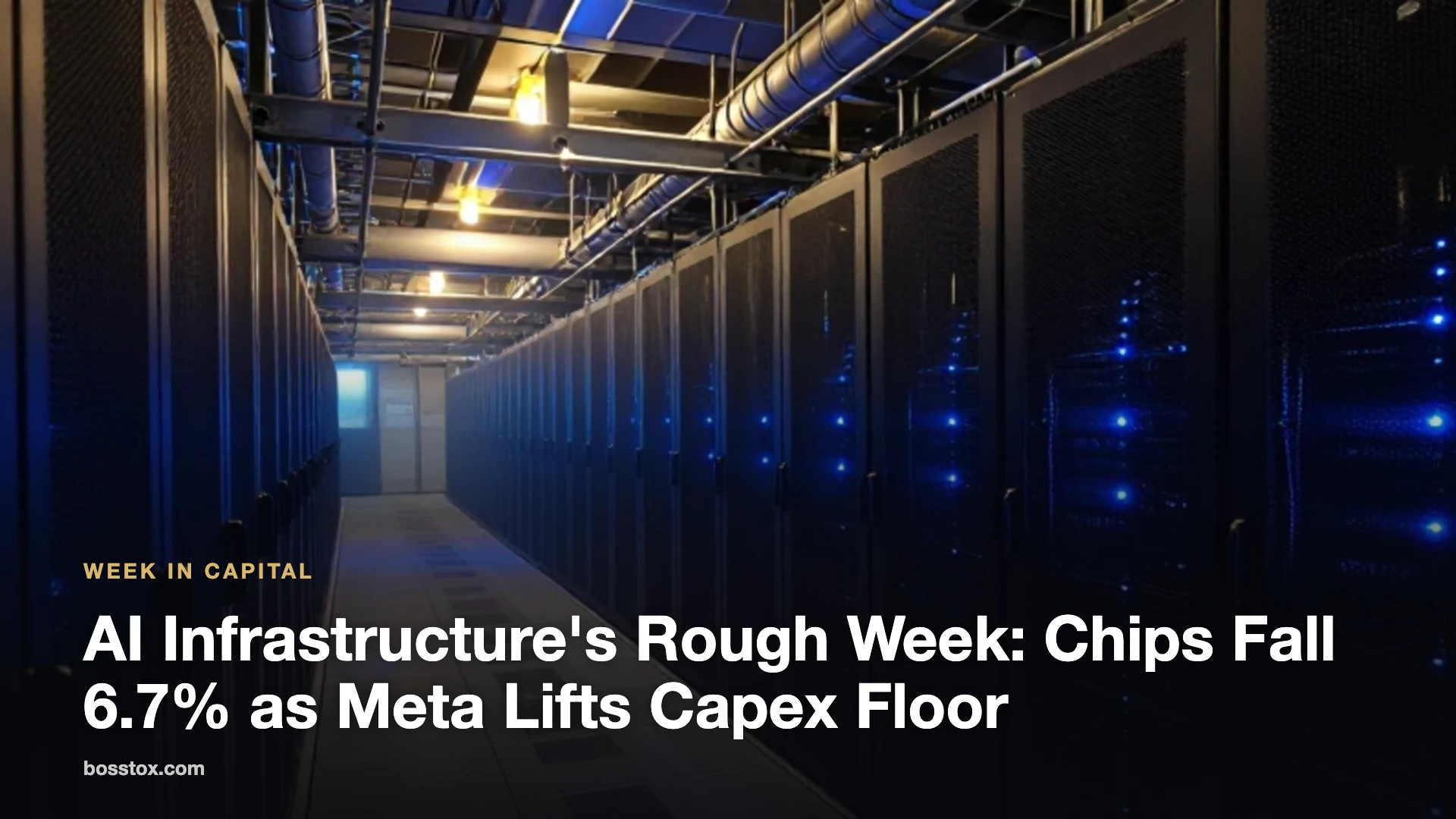
The AI-infrastructure trade had its worst day since June on Thursday, Oct. 22, 2026, when the Philadelphia Semiconductor Index fell 6.7% and the Nasdaq Composite dropped 2.6% after Meta Platforms raised the floor of its 2026 capital budget to $135 billion while reporting its first quarterly cash outflow in more than a decade, and chip-equipment maker Lam Research blamed supply constraints for a softer forecast.
The tape: a flat-looking week that was anything but
The weekly numbers understate the violence. Kitco and Reuters data put the S&P 500 down about 0.5% for the week of Oct. 19-23, the Nasdaq Composite down 0.7% and the Dow Jones Industrial Average up 0.4%. The Associated Press said the S&P 500 recorded its second straight weekly loss. Reuters reported Friday’s closes at 7,629.92 for the S&P 500, down 0.43%, 25,986.95 for the Nasdaq, down 0.08%, and 52,241.55 for the Dow, down 626.43 points or 1.18%.
Inside that range, the market rallied Wednesday, with the Nasdaq up 1.05% to 26,702.86 and the S&P 500 up 0.58% to 7,757.17, according to Kitco, then gave it all back Thursday. The Nasdaq fell 694 points to 26,008.86, its steepest one-day drop since early June, and the S&P 500 lost 1.21% to 7,663.43, Reuters reported. The Philadelphia Semiconductor Index’s 6.7% decline was its largest since June 23; the index is now more than 26% below its June 22 record close even after a 51.5% gain for the year. The S&P 500 is up 11.9% in 2026.
What triggered it: Meta’s cash, Lam’s constraints
Meta reported third-quarter revenue of $64.6 billion, up 26%, net income of $9.8 billion and earnings of $3.83 a share on Wednesday evening, Forbes reported. Capital spending in the quarter was $34.9 billion, and the company raised its full-year 2026 capex guidance to $135 billion to $145 billion from $130 billion to $145 billion. It also announced a two-for-one split that will hand each Class A holder a non-voting Class C share, a structure the company could use to raise capital, and Reuters reported that Meta posted its first quarterly cash outflow in more than a decade because of AI spending. Forbes reported the shares initially rose more than 3% after the release; they fell 7% in Thursday’s regular session.
Lam Research compounded the mood. Chief financial officer Doug Bettinger said the company’s $8.6 billion revenue guidance “would have been a bit higher if not for some near-term supply chain constraints,” Yahoo Finance reported. Sources differ on the damage: Yahoo Finance reported Lam fell as much as 11% intraday, while GuruFocus and Seeking Alpha put the closing loss near 12%. Applied Materials fell 7% and ASML 6% in sympathy. Reuters reported that Intel, AMD, Marvell and Sandisk each lost more than 8%; Yahoo Finance had Broadcom down more than 4%; and Micron fell about 6% while Nvidia closed down 4.4% at $212.21, according to market data compiled by HeyGoTrade. Tesla slipped 3.1% despite positive free cash flow and a cut to its 2026 capital spending plans.
Paul Nolte of Murphy & Sylvest told Reuters, “Investors are starting to realize that there are some holes in the AI story.” On Friday, Man Group’s Kristina Hooper told Reuters, “There is still fallout from the questioning of the AI trade,” and warned that less may be invested in AI data-center construction next year than projected.
The cost of capital is the real story
For BOSSTOX readers, the chip tape matters less than the financing backdrop. The 10-year Treasury yield reached about 5.14% on Tuesday, Kitco reported, then fell to 4.96% late Thursday as money fled equities for bonds before ending Friday at 4.99%, according to the AP. The Federal Reserve, which raised its benchmark rate on Sept. 16 to a range of 3.75% to 4%, meets Oct. 27-28; CME FedWatch pricing cited by Reuters gives a 92% chance of a hold and a 78% chance of a December hike.
The AP put the link plainly: many AI companies have borrowed to fund infrastructure, and high interest rates are making that debt costlier. Angelo Kourkafas of Edward Jones told the AP that “investors appear increasingly focused on the economics of AI.” Meta’s non-voting share class is one answer to that scrutiny, equity rather than debt, and the market’s 7% response suggests how equity holders feel about dilution funding data centers.
Inflation is now part of the capex calculus too. The AP reported Goldman Sachs estimates that the data-center buildout has added about half a percentage point to U.S. inflation by driving up prices for semiconductors and electrical components. Brent crude climbed above $111 a barrel Friday, per the AP, lifting the energy sector to a record and reinforcing the rate outlook that makes long-dated infrastructure projects harder to finance.
Power and cooling: the read-through
Equipment and power names did not escape. Lam’s “supply chain constraints” comment is a reminder that the bottleneck has moved upstream from GPUs to the tools, substrates and components that make them, and the same is true of transformers, switchgear and chillers. Vertiv, the thermal and power specialist, reports third-quarter results before the market opens Wednesday, Oct. 28, with a call at 11 a.m. Eastern, according to its investor relations site. Its backlog commentary will be the week’s cleanest signal on whether hyperscaler capex is translating into orders for cooling and power gear or stalling at the planning stage. Nvidia’s modular AI-factory reference design, unveiled Oct. 21 and covered earlier this week on BOSSTOX, names power and cooling vendors as launch partners, which raises the stakes for Vertiv’s guidance.
The calendar
Next week is the densest of the quarter. Alphabet, Microsoft and Amazon all report, and Reuters noted that roughly a third of S&P 500 companies will release results, with capital-spending forecasts under the microscope. LSEG data cited by Reuters put third-quarter S&P 500 earnings growth on track for more than 32%, and 83% of the 111 companies that had reported by Thursday beat expectations. The Fed decision lands Wednesday at 2 p.m. Eastern, the September PCE inflation report follows Thursday morning, and the Nov. 3 midterm elections are the week after. The University of Michigan’s consumer sentiment index sat at 48.0 in October, near a record low, Kitco reported, a reminder that the consumer side of the economy is not matching the capex side.
The BOSSTOX Take
Thursday was not a verdict on AI demand; Meta grew revenue 26% and raised its spending floor. It was a verdict on how that spending is funded. When a company with $64.6 billion in quarterly revenue runs cash-flow negative and creates a non-voting share class, equity investors are being asked to finance infrastructure that debt markets, at 5% Treasury yields, price expensively. The backlog data from Vertiv and the hyperscalers next week will show whether the buildout is slowing or simply getting more expensive to finance. BOSSTOX reports on AI infrastructure and does not provide investment advice.
What it means for you
- Operators and builders: lenders are repricing data-center debt against a 10-year yield near 5%; expect tighter covenants and higher spreads on new project financing.
- Suppliers: Lam’s comment confirms upstream constraints; power, cooling and substrate vendors with delivery slots in 2027 hold pricing power.
- Watch Vertiv on Oct. 28 and the hyperscaler capex lines next week for backlog growth, not just headline spending; the two can diverge.
- The Fed’s Wednesday statement and Thursday’s PCE report set the rate path that governs every long-dated infrastructure model.
- Equity-funded capex, as in Meta’s Class C plan, shifts risk from bondholders to shareholders; expect more such structures if yields stay high.
Test yourself
1. How much did the Philadelphia Semiconductor Index fall on Oct. 22, and how far is it from its record?
Answer: It fell 6.7%, its largest drop since June 23, and sits more than 26% below its June 22 record close despite a 51.5% gain for the year.
2. What did Meta change in its 2026 capital spending guidance?
Answer: It raised the range to $135 billion to $145 billion from $130 billion to $145 billion, lifting the floor by $5 billion.
3. Why does Meta’s stock split matter for infrastructure financing?
Answer: The split issues non-voting Class C shares that the company could use to raise capital, a way to fund AI buildout with equity rather than debt.
4. When does Vertiv report third-quarter results?
Answer: Before the market opens on Wednesday, Oct. 28, 2026, with a conference call at 11 a.m. Eastern.
Discussion
- Is a hyperscaler that funds data centers with non-voting equity more or less committed to the buildout than one that borrows?
- If supply constraints are moving upstream to tools and substrates, which parts of the power and cooling chain are next?
- Should the Fed’s rate path, rather than GPU demand, be the primary variable in an AI-infrastructure capacity model for 2027?
From the network
- Boston Made Reader — every story from the family in one free reading app.
- Lumo — live gold, silver and platinum prices, a melt-value calculator and local dealer quotes.
- Boston Made Newsroom — company news and announcements from Boston Made, Inc.
Sources
- Associated Press — Wall Street loses ground under pressure from rising oil prices
- Associated Press — Inflation worsened last month to 3.7% as midterm elections near
- Reuters — Nasdaq plunges 2.6% as AI spending fears spark tech selloff
- Reuters — Dow, S&P 500 fall, tech steadies to end rocky week
- Reuters — Gold set for steep weekly loss as rising oil prices bolster Fed rate hike bets (Fed pricing)
- Forbes — Meta posts $64 billion in revenue and announces stock split in Q3 earnings
- Yahoo Finance — Chip stocks fall as equipment maker Lam Research cites ‘supply chain constraints’
- GuruFocus — Lam Research shares drop 12% after earnings despite beat
- Seeking Alpha — Lam Research retreats 12% amid cautious guidance, China revenue drop
- The Motley Fool — Why Intel stock fell today
- HeyGoTrade — Nvidia stock news: NVDA falls 4.4% to $212.21 (Oct. 22 session)
- Kitco — Gold gains as Treasury yields stabilize, Nasdaq surges (PM report, Oct. 21)
- Kitco — Weekly index moves and Michigan sentiment (PM report, Oct. 23)
- USAGOLD — Daily market report, Oct. 20, 2026 (10-year yield)
- Vertiv — Announces date of third quarter 2026 earnings release and conference call

Twenty Minutes, $6.36 Billion: Inside the Binance Heist and What It Means for Everyone Who Holds Assets on an Exchange

InfiniBand vs. Ethernet for AI Clusters

The BOSSTOX App: Markets and the AI Build-Out on iPhone, iPad and Apple Watch

AI Server Rack Power Density, 2024-2027

Gas Turbines on Data-Center Campuses

Transformer Lead Times Are Becoming a Data-Center Schedule Risk

GPU Supply Chains: How AI Hardware Gets Made, Moved, and Bottlenecked

Water Use and Dry Coolers: The Tradeoff AI Sites Cannot Avoid
Twenty Minutes, $6.36 Billion: Inside the Binance Heist and What It Means for Everyone Who Holds Assets on an Exchange
InfiniBand vs. Ethernet for AI Clusters
The BOSSTOX App: Markets and the AI Build-Out on iPhone, iPad and Apple Watch
AI Server Rack Power Density, 2024-2027
-
 Power & Grid3 weeks ago
Gas Turbines on Data-Center Campuses
-
 Power & Grid3 weeks ago
Transformer Lead Times Are Becoming a Data-Center Schedule Risk
-
 Compute & Silicon4 weeks ago
GPU Supply Chains: How AI Hardware Gets Made, Moved, and Bottlenecked
-
 Cooling1 month ago
Water Use and Dry Coolers: The Tradeoff AI Sites Cannot Avoid
-

 Power & Grid2 weeks ago
Battery Storage at AI Sites
-

 Explainers1 month ago
Explainer: What an AI Inference Stack Actually Does
-
 Power & Grid2 weeks ago
Small Modular Reactors: Timelines vs. Headlines
-
 Compute & Silicon3 weeks ago
HBM Is a Bottleneck Because AI Memory Is a Stack, Not a Chip